

20 Short Shag Hairstyles Over 60 That Add Volume & Softness

Your hair after 60 often behaves differently than it used to. It can be finer at the crown, coarser where the gray grows in, flatter by noon, and less willing to hold a blowout. A one-length bob can start to look heavy at the bottom and thin on top. That is the problem short shag hairstyles for women over 60 solve well: strategic layers move the weight up toward the crown, frame the face with softness instead of hard lines, and let natural wave or bend do the styling work.
This Hairstyle Inspirations guide covers 20 short shags, from feathery pixie-length cuts to collar-grazing layered styles, with realistic maintenance details for each one. You’ll find straight, wavy, curly, and coily options, plus clear guidance on fine versus thick hair.
Quick Overview: Which Short Shag Fits Your Hair?
- Best for fine or thinning hair: A choppy pixie shag or wispy chin-length shag, because short, point-cut layers create lift without removing the density you need at the ends.
- Best for thick or coarse hair: A razor shag or stacked shag, where internal thinning removes bulk so the cut doesn’t puff out sideways.
- Lowest maintenance: The coily tapered shag and silver micro-shag, which air-dry in about 5 minutes and need little to no heat styling.
- Best for curls and coils: Curly crown shags and coily tapered shags cut dry, curl by curl, so each curl falls into its natural shape.
- Trim frequency: Pixie-length shags need a trim every 4–6 weeks; chin- to collar-length shags hold their shape for 6–10 weeks.
- Color touch-up: Root touch-ups run every 4–6 weeks for full coverage; gray blending and natural silver stretch to 3–4 months or need only a toning gloss every 6–8 weeks.
What Is a Short Shag Haircut?
A short shag is a layered haircut, usually 2 to 7 inches long, built with choppy layers concentrated at the crown and thinner, piece-y ends around the face and nape. The layers create height on top and movement throughout, so the shape looks fuller and softer than a blunt cut of the same length.
The difference between a shag and a standard layered cut is where the weight sits. Regular layers often blend evenly from top to bottom. A shag deliberately keeps the crown short and shaggy while the perimeter stays wispy and broken up, which creates that signature lived-in, slightly undone shape.
Stylists typically build shags with a razor, point-cutting, or slide-cutting, and many cut curly versions dry. For mature hair, the technique matters: a heavy razor can fray fine or brittle ends, so fine hair usually does better with point-cutting, while thick hair benefits from razor work or texturizing shears.
20 Short Shag Hairstyles for Women Over 60
Arranged from shortest to longest.
1. Feathered Pixie Shag
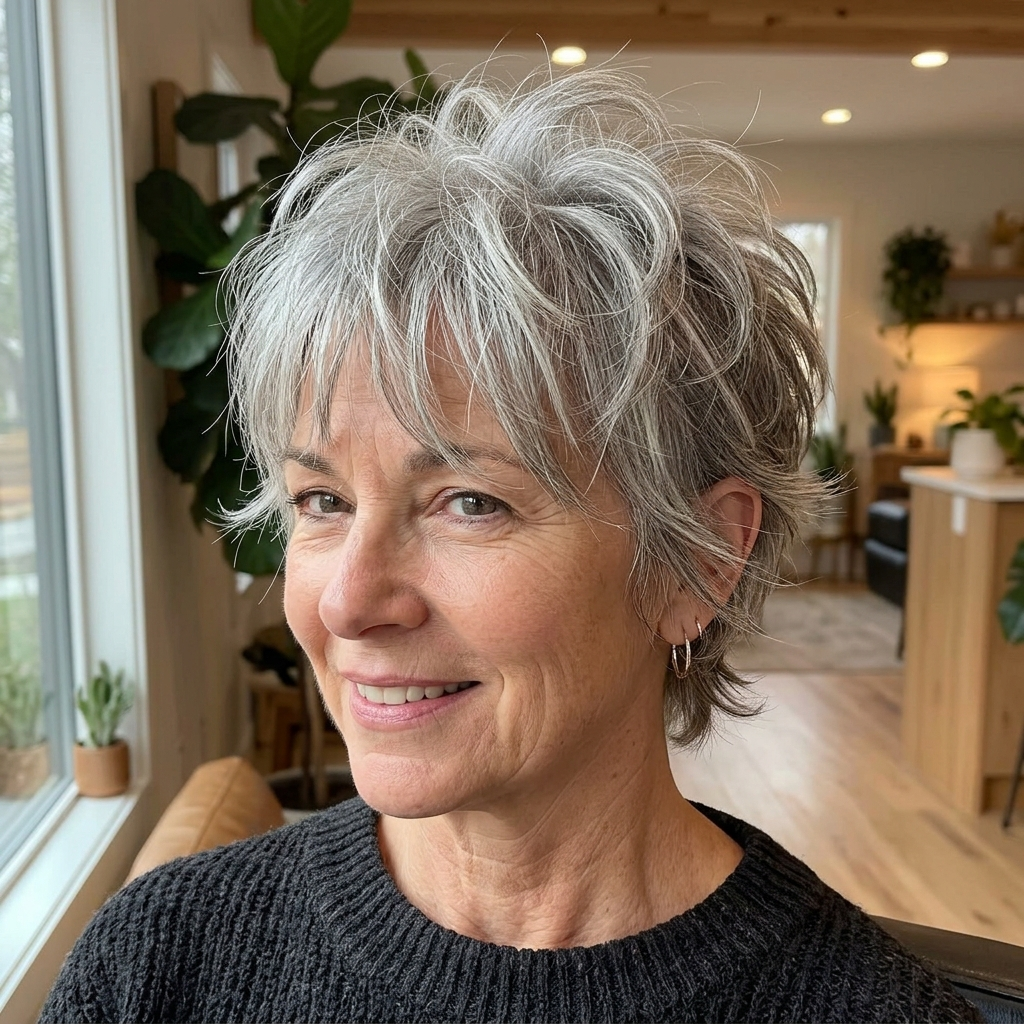
The shortest shag here keeps the sides close and the crown loaded with short, feathery layers that lift straight up from the root. Wispy pieces fall forward onto the forehead and around the ears, softening the overall shape so it reads gentle rather than severe.
Fine, straight hair shows the feathering most clearly, while slightly coarse gray hair gives the crown extra natural lift. To style, work a pea size amount of texture paste through damp hair, rough-dry with your fingers, and pinch a few ends at the crown.
Best for: Fine to medium straight hair, oval or heart-shaped faces
- Length: 1.5–3 inches
- Maintenance: Medium
- Styling time: 5–10 min
- Trim every: 4–5 weeks
- Color touch-up: 4–6 weeks (or natural gray)
2. Silver Micro-Shag with Wispy Nape

Natural silver hair has a wiry texture that holds a shag beautifully, and this cut leans into it. The crown layers are slightly longer than a pixie, the nape is tapered into soft, wispy points, and the overall shape stays close to the head.
A violet-toned gloss every couple of months keeps silver from turning yellow under hard water or sun. Air-drying works well here; a light cream controls frizz without flattening the crown.
Best for: Natural silver or white hair, medium density, straight to slightly wavy texture
- Length: 2–3.5 inches
- Maintenance: Low
- Styling time: 5 min
- Trim every: 5–6 weeks
- Color touch-up: None needed (optional toning gloss every 6–8 weeks)
3. Coily Tapered Shag

Type 4 coils get a shag shape when the sides and nape are tapered short and the crown is left fuller and rounded, with defined coils sitting on top. Cut dry, each coil is shaped individually so the silhouette stays even as it shrinks.
This is one of the easiest washday cuts on the list: apply a leave-in conditioner and curl cream to soaking-wet hair, then let it air-dry or diffuse on low. Gray coils can be drier and more porous, so a weekly deep conditioner keeps definition crisp.
Best for: Type 4A–4C coily hair, any density
- Length: 1–4 inches (shorter at sides, longer at crown)
- Maintenance: Low
- Styling time: 5–10 min
- Trim every: 6–8 weeks
- Color touch-up: 6–8 weeks for coverage, or natural gray
4. Choppy Textured Pixie Shag

Deliberately uneven, point-cut ends give this shag a piece-y, broken-up finish that makes fine hair look denser than it is. Instead of smooth layers, the stylist chips into the hair so the ends separate into small, textured clusters.
Thin crowns benefit most, because the choppy pieces disguise scalp show-through. A dry texture spray at the roots and a quick blast with the dryer is usually all it takes.
Best for: Fine or thinning hair, especially at the crown
- Length: 2–4 inches
- Maintenance: Medium
- Styling time: 5–10 min
- Trim every: 5–6 weeks
- Color touch-up: 4–6 weeks; soft lowlights stretch to 8–10 weeks
5. Shaggy Pixie with Long Side-Swept Fringe

A longer fringe, around 4 to 5 inches, sweeps diagonally across the forehead and blends into short shaggy layers through the back. The asymmetry draws attention to the eyes and cheekbones while softening forehead lines.
Medium-thickness straight or slightly wavy hair holds the sweep without needing much product. Blow-dry the fringe in the direction you want it to fall, using a small round brush or your fingers, then mist with flexible hairspray.
Best for: Medium-density straight to wavy hair, round or square faces
- Length: 2–5 inches
- Maintenance: Medium
- Styling time: 10 min
- Trim every: 5–6 weeks (fringe every 3–4 weeks)
- Color touch-up: 4–6 weeks
6. Curly Crown Shag with Tapered Sides
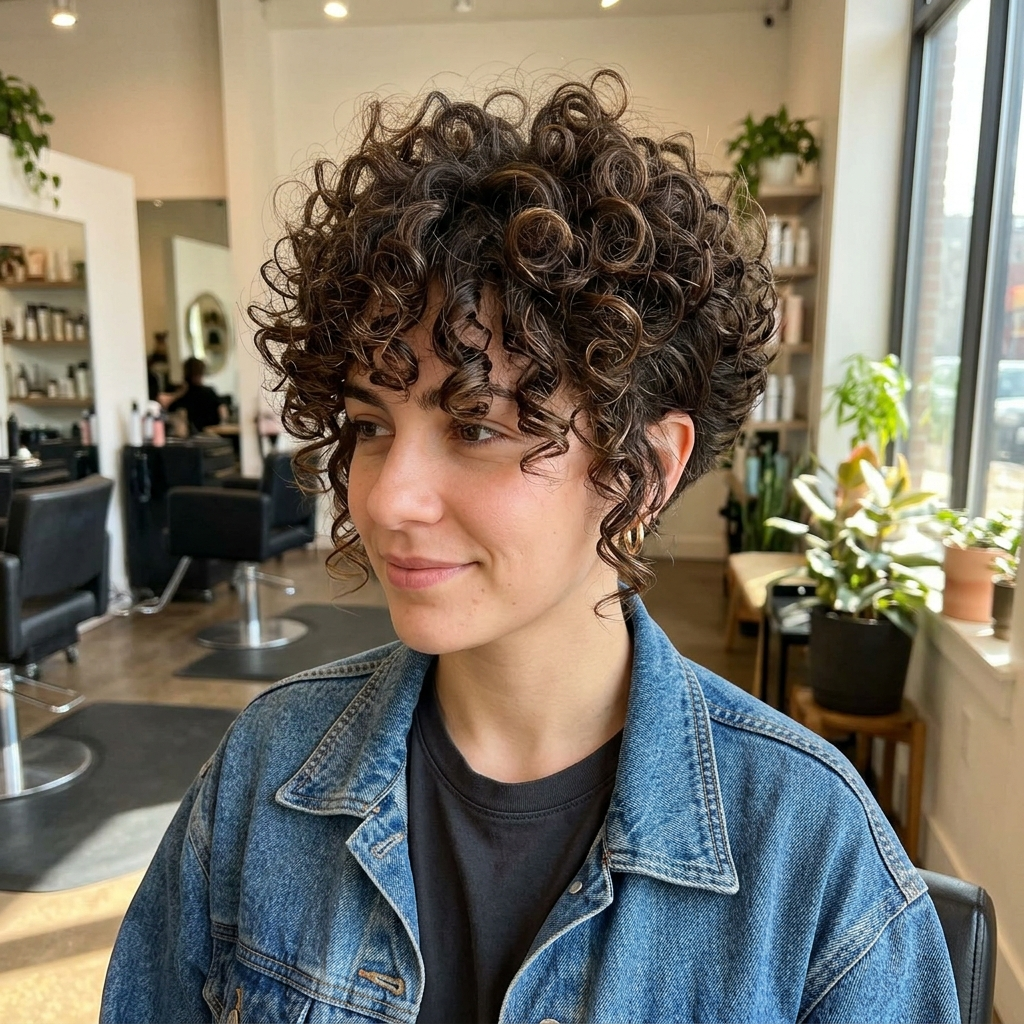
Type 3 curls stack up at the crown while the sides are taken shorter, so volume sits on top instead of widening the head. The result is round, bouncy, and bright, with curls tumbling forward around the face.
Cutting dry lets the stylist see where each curl springs up. Scrunch a curl cream or gel into wet hair, diffuse on low heat, then “scrunch out the crunch” once fully dry. A satin pillowcase helps curls last to day two or three.
Best for: Type 3A–3C curly hair, medium to thick density
- Length: 2–5 inches (curled length)
- Maintenance: Low to Medium
- Styling time: 10–15 min
- Trim every: 8–10 weeks
- Color touch-up: 6–8 weeks, or natural gray
7. Salt and Pepper Razor Shag

Thick hair that’s partway through going gray gets a lot from a razor shag. Razor-cut layers thin out bulk and create soft, tapered ends, and the mix of dark and gray strands adds natural dimension. The texture contrast is the point here, so color stays minimal. Rough-dry with a light mousse and finish with a tiny amount of pomade on the ends. Avoid razor work if your ends are dry or prone to splitting; ask for texturizing shears instead.
Best for: Thick, coarse, straight to wavy hair with natural salt-and-pepper color
- Length: 3–5 inches
- Maintenance: Low
- Styling time: 10 min
- Trim every: 6 weeks
- Color touch-up: None needed (optional clear gloss every 8 weeks)
8. Soft Bixie Shag

The bixie blends a pixie and a bob: it’s long enough to tuck behind the ears but layered short at the crown like a pixie. As a shag, the edges are feathered and the back is softly rounded, giving a cozy, full shape that grows out gracefully.
It flatters women transitioning from a pixie to something longer. Medium-density hair with a little bend works best; blow-dry with a round brush at the crown for lift.
Best for: Fine to medium hair, straight or with a slight wave
- Length: 3–5 inches
- Maintenance: Medium
- Styling time: 10–15 min
- Trim every: 6–7 weeks
- Color touch-up: 4–6 weeks
9. Stacked Shag with Rounded Back
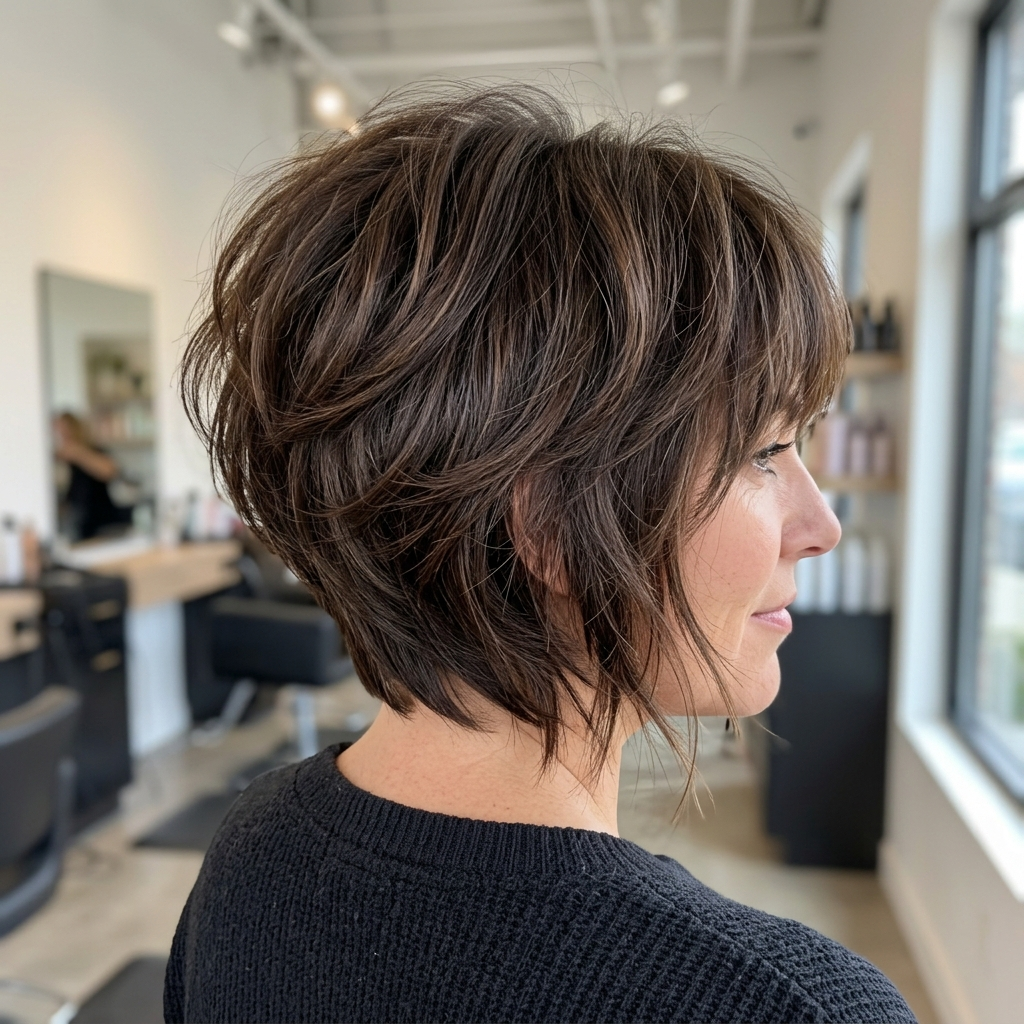
Graduated layers stack at the back of the head to create a rounded, lifted shape, while the front stays shaggy and soft. Women whose hair goes flat at the back of the head get the most from this cut, because the stacking builds volume exactly where it’s lost. Thick hair holds the shape longest. Blow-dry the back with a round brush pulled up and away from the nape, then tousle the front with your fingers.
Best for: Medium to thick straight hair, women with a flat back crown
- Length: 2–5 inches
- Maintenance: Medium
- Styling time: 10–15 min
- Trim every: 5–6 weeks
- Color touch-up: 4–6 weeks
10. Ear-Length Shag with Curtain Bangs

Center-parted curtain bangs swing outward toward the cheekbones, opening up the face while the shaggy layers fall just past the ears. The curtain fringe creates a gentle frame that works especially well on long or oval faces.
This cut does need a little daily attention: blow-dry the bangs with a medium round brush, rolling each side away from the face. Straight to wavy hair of any density handles it, though very fine bangs may separate.
Best for: Straight to wavy hair, medium density, long or oval faces
- Length: 3–5 inches (bangs 4–6 inches)
- Maintenance: Medium
- Styling time: 10–15 min
- Trim every: 6 weeks (bangs every 3–4 weeks)
- Color touch-up: 4–6 weeks
11. Wispy Chin-Length Shag for Fine Hair

Fine, straight hair needs layers that add movement without taking away weight from the ends. Here, the crown is lightly layered, the perimeter stays mostly intact, and only the very ends are point-cut into soft wisps around the jaw. The finished shape looks airy rather than stringy. Use a lightweight volumizing mousse at the roots, blow-dry upside down for a minute, then flip back and smooth the ends.
Best for: Fine, straight hair with low to medium density
- Length: 5–7 inches
- Maintenance: Low to Medium
- Styling time: 10 min
- Trim every: 6–8 weeks
- Color touch-up: 4–6 weeks; babylights stretch to 10–12 weeks
12. Wavy Chin Shag with Face-Framing Layers

Natural Type 2 waves turn this cut into the classic lived-in shag: tousled, bendy layers around the chin with shorter pieces starting at the cheekbones. Face-framing layers pull attention upward and brighten the face.
A sea salt or wave spray scrunched into damp hair, then diffused or air-dried, gives the most natural finish. If waves have softened with age, a 1.25-inch curling iron can add bends to a few pieces.
Best for: Type 2A–2C wavy hair, medium density
- Length: 5–7 inches
- Maintenance: Low
- Styling time: 10 min
- Trim every: 7–8 weeks
- Color touch-up: 6–8 weeks; face-framing highlights 10–12 weeks
13. Blunt Perimeter Shag for Thinning Ends

Hair that gets wispy and see-through at the ends needs a shag with a solid outline. This version keeps a blunt, chin-level perimeter while shaggy layers are cut only internally and at the crown, so the bottom edge looks thicker.
It’s a smart option for women whose hair has thinned from age, medication, or hormone changes. Blow-dry smooth with a flat brush and add texture spray only at the top.
Best for: Fine or thinning hair, especially at the ends
- Length: 5–6 inches
- Maintenance: Medium
- Styling time: 10–15 min
- Trim every: 6–8 weeks
- Color touch-up: 4–6 weeks
14. Micro-Fringe Shag

A bold choice: very short, choppy bangs sitting well above the brows, paired with shaggy layers that end around the ears or chin. The short fringe brings an artsy, confident edge and highlights the eyes. It’s best on women with a smaller forehead or strong brows who enjoy making a statement. Fine to medium straight hair keeps the fringe neat; strong cowlicks at the hairline can make it unpredictable.
Best for: Fine to medium straight hair, oval or heart-shaped faces, no strong cowlicks
- Length: 3–6 inches (fringe 1–2 inches)
- Maintenance: High
- Styling time: 10 min
- Trim every: 5–6 weeks (fringe every 2–3 weeks)
- Color touch-up: 4–6 weeks
15. Platinum-White Shag with Icy Gloss

For women who love brightness, a crisp platinum or pure white shag reads modern and polished. The layers are kept soft, with movement through the crown and side-swept ends. If your natural gray is patchy, a colorist can blend it to an even white with fine highlights and a cool-toned gloss. Lightened hair is more fragile, so use a heat protectant every time, a bond-building treatment weekly, and a purple shampoo once a week.
Best for: Natural white or gray-blended hair, fine to medium density, cool or neutral skin undertones
- Length: 3–6 inches
- Maintenance: Medium to High
- Styling time: 10 min
- Trim every: 6 weeks
- Color touch-up: Toning gloss every 6–8 weeks; blending highlights every 3–4 months
16. Curly Chin-Length Shag

Longer than the curly crown shag, this version lets Type 3 curls fall to the chin with shaggy layers that prevent the triangle shape curls can form when cut one length. The crown is layered to lift curls at the root, while the sides spiral down around the face. Medium to thick curls show the most shape. Apply styler to soaking-wet hair, plop in a cotton T-shirt for 15 minutes, then diffuse.
Best for: Type 3A–3C curls, medium to thick density
- Length: 5–8 inches (curled length)
- Maintenance: Low to Medium
- Styling time: 15–20 min
- Trim every: 8–12 weeks
- Color touch-up: 6–8 weeks, or natural gray
17. Retro Flipped End Shag

A nod to the 1970s, this shag has a full, rounded crown with ends that flip outward just below the ears. The flipped perimeter gives a playful, polished look that feels intentional even on low-effort days.
Medium-thick straight hair holds the flip best. Blow-dry with a large round brush, rolling the ends outward, then set with a light-hold hairspray. On humid days, a quick pass with a flat iron keeps the flip crisp.
Best for: Medium to thick straight hair
- Length: 4–6 inches
- Maintenance: Medium to High
- Styling time: 15–20 min
- Trim every: 6 weeks
- Color touch-up: 4–6 weeks
18. Soft Wolf-Inspired Shag

The wolf cut blends a shag and a mullet, but this mature-friendly version keeps the contrast subtle: a full, choppy crown with slightly longer, wispy pieces at the nape and sides. It suits women who want something fashion-forward without a dramatic look. Thick, wavy hair gives it the right amount of texture. Scrunch in texture spray, rough-dry, and twist a few pieces with a flat iron for definition.
Best for: Thick, wavy hair with natural movement
- Length: 3–7 inches
- Maintenance: Medium
- Styling time: 10–15 min
- Trim every: 6–7 weeks
- Color touch-up: 6–8 weeks; lived-in color 3–4 months
19. Jaw Length Shag with Dimensional Lowlights

Lowlights, fine strands a shade or two darker than the base, add depth to gray or light blonde hair that can look flat in photos. Paired with jaw-length shag layers, they make each layer more visible and give the illusion of thicker hair.
Ask for lowlights in ash brown or soft caramel woven through gray or blonde. Style smooth with a round brush or loosely waved with a 1.5-inch curling wand.
Best for: Gray, white, or light blonde hair, fine to medium density
- Length: 5–7 inches
- Maintenance: Medium
- Styling time: 10–15 min
- Trim every: 6–8 weeks
- Color touch-up: Lowlights every 8–12 weeks
20. Collar Length Shaggy Lob

The longest option on the list skims the collar, around 7 to 9 inches, with long shag layers starting at the cheekbone and soft, curtain-style front pieces. It’s a gentle entry point if you’re not ready for a short cut yet still want more volume. Wavy or straight hair of medium to thick density holds the shape. Air-dry with a wave cream or blow-dry and loosely bend with a large-barrel iron.
Best for: Medium to thick straight or wavy hair, women not ready for a very short cut
- Length: 7–9 inches
- Maintenance: Low to Medium
- Styling time: 10–15 min
- Trim every: 8–10 weeks
- Color touch-up: 6–8 weeks; balayage 3–4 months
How Do I Choose the Right Short Shag After 60?
Start with your hair’s density and natural texture, then match the length to how much daily styling you’ll realistically do. Fine hair needs lighter layering and a stronger perimeter; thick hair needs bulk removed. If you want under 10 minutes of styling, choose a cut that works with your natural texture rather than against it.
A few factors refine the choice:
- Face shape: Curtain bangs and side-swept fringe soften long or square faces; crown height elongates round faces.
- Skin undertone: Cool undertones often glow with icy white or silver; warm undertones tend to look brighter with soft caramel or golden lowlights.
- Lifestyle: Pixie shags look sharp but need trims every 4–6 weeks. Chin- and collar-length shags stretch to 8–10 weeks.
- Budget: Natural gray and silver cut maintenance costs significantly. Full-coverage color, frequent fringe trims, and platinum toning add up.
Which Short Shag Works Best for Fine, Thick, Wavy, Curly, or Coily Hair?
The best shag depends on how your hair holds layers. Fine hair needs fewer, shorter crown layers and a fuller perimeter; thick hair needs internal thinning; wavy and curly hair needs dry or curl-by-curl cutting; coily hair needs a tapered shape that respects shrinkage.
Fine hair: Too many layers can leave fine ends looking sparse. Choose point-cut layers at the crown and keep weight around the perimeter, as with the choppy pixie shag or blunt-perimeter shag.
Thick hair: Without removing bulk, a shag can widen into a mushroom shape. Razor work or texturizing shears thin the interior so the layers lie down and move.
Wavy hair: Waves naturally separate into shaggy pieces, so a wavy shag usually needs less styling than a straight one. Shorter face-framing layers also encourage waves to form near the face.
Curly hair: Curls shrink and spring up differently strand by strand, so cutting dry prevents surprises. Layering the crown stops curls from settling into a triangle.
Coily hair: Tapered sides with a fuller crown give the shag shape while keeping wash-and-go styling simple. Gray coils often need more moisture to stay defined.
How Do I Care for a Short Shag at Home?
Care comes down to moisture, light products, and gentle heat. Mature hair, especially gray, is often drier and more porous, so wash less often, protect it from heat, and use lightweight stylers that won’t weigh down the crown layers.
- Wash 2–3 times a week with a sulfate-free, color-safe shampoo. Silver and white hair can use a purple shampoo once a week.
- Condition mid-lengths to ends, keeping heavier products off the roots to preserve crown lift.
- Apply heat protectant before every blow-dry or iron session.
- Use one main styler suited to your texture: volumizing mousse for fine hair, wave spray for Type 2, curl cream or gel for Type 3–4.
- Dry the crown first, lifting roots with fingers or a round brush before the hair sets flat.
- Finish with dry texture spray or a pea-size pomade to separate the shaggy ends.
- Refresh between washes with dry shampoo at the roots or a water mist for curls.
- Book a toning gloss every 6–8 weeks if you have gray, silver, or blonde hair that yellows or brasses.
How Do I Grow Out a Short Shag?
Growing out a shag is easier than growing out a blunt cut, because layered ends blend as they lengthen. Plan for 3 to 6 months of in-between length, and keep trimming every 8–10 weeks to shape the back and sides while the crown catches up.
During the transition, ask for “dusting” trims that remove only split ends and keep the perimeter balanced. The back often grows faster visually, so trimming the nape keeps the shape from looking mullet-like. Curtain bangs or side-swept fringe are helpful bridges as front layers grow out. If you’re also transitioning to natural gray, soft lowlights or gray blending can make the line between colored and natural hair less obvious.
FAQ: Short Shag Hairstyles for Women Over 60
Is a short shag good for thin hair after 60?
Yes, a short shag can work well on thin hair if the layers are kept light and concentrated at the crown. Point-cut layers add lift and texture, while a fuller perimeter keeps the ends from looking sparse. Heavy razor layering is best avoided on very fine hair.
Can a shag hide thinning at the crown?
A shag can make thinning at the crown less noticeable by adding height and choppy texture on top. Piece-y layers break up the surface so the scalp shows through less. Texture spray or root-lifting mousse helps the effect, though no haircut replaces medical advice for significant hair loss.
How often should I trim a short shag?
Pixie-length shags usually need a trim every 4–6 weeks, while chin- and collar-length shags can go 6–10 weeks. Curly and coily shags often hold their shape longer, around 8–12 weeks. Bangs and micro-fringe may need a quick trim every 2–4 weeks.
Does a short shag work with gray or silver hair?
Short shags work well with gray and silver hair because the coarser texture of gray strands holds layers and lift. A toning gloss or purple shampoo keeps silver bright. Salt-and-pepper hair especially benefits, since the layers show off natural dimension.
Do short shags need daily styling?
Most short shags need 5–15 minutes of styling, and many can be air-dried. Wavy, curly, and coily shags often look best with minimal effort. Straight hair, flipped styles, and bangs usually need a quick blow-dry to look polished.
What’s the difference between a shag and a pixie cut?
A pixie is a very short cut, usually smooth and close to the head. A shag focuses on choppy, layered texture with crown volume and wispy ends. A pixie shag combines both: pixie length with shaggy, textured layers.
Is a short shag good for a round face?
A short shag can flatter a round face when the layers add height at the crown and the sides stay closer to the head. Side-swept fringe or longer face-framing pieces past the cheekbones help create a longer appearance. Wide, rounded volume at the cheeks is best avoided.
Can I get a short shag with curly hair?
Yes, curly hair suits shags well, especially when the cut is done dry, curl by curl. Layering the crown prevents a triangle shape and adds bounce. Curly shags usually need trims every 8–12 weeks and styling with curl cream or gel.
Finding Your Short Shag
If you want the most volume with the least effort, start with a wavy chin shag or curly crown shag that works with your natural texture. For fine or thinning hair, the choppy pixie shag or blunt-perimeter shag adds fullness without sacrificing density. If you love bold statements, try the micro-fringe or platinum-white shag.
Bring this guide from Hairstyle Inspirations to your salon so you can point to the exact shape and maintenance you want. Save your favorite styles to Pinterest, and explore more Hairstyle Inspirations guides for cuts and color ideas that grow with you.


