
20 Short Shag Haircuts for Women Over 50 with Glasses

Your frames are part of your face, but most haircut photos are shot without them. That mismatch matters: a fringe that looks breezy on Pinterest can sit right on your brow bar, and heavy side layers can wedge behind your temple arms and push your glasses forward. The right short shag haircuts for women over 50 work with your eyewear. They lift the crown where hair tends to thin, keep weight off the ears, and frame the eyes instead of fighting the frames.
Below, the Hairstyle Inspirations team has gathered 20 short shags arranged from shortest to longest, with practical numbers for each: length, styling time, trim schedule, and color upkeep. You’ll also find how to match a shag to your frame style, your texture, and the amount of time you actually want to spend at the mirror.
Quick Overview: Choosing a Short Shag with Glasses
- Best for fine or thinning hair: a stacked shag bob or feathered pixie shag, because short interior layers create lift without removing the bulk fine hair needs at the ends.
- Best for thick hair: a razor-cut or choppy shag, which removes internal weight so the shape doesn’t puff out around your frames.
- Lowest maintenance: the silver pixie shag with a tapered nape about 5 minutes of styling with fingers and a little cream.
- Best for curls and coils: a curly or coily shag cut dry, curl by curl, so the shape is set by your actual spring pattern.
- Trim frequency: every 4–6 weeks for pixie-length shags; every 6–8 weeks for chin- to neck-length shags.
- Color touch-up timing: every 4–6 weeks for full gray coverage; every 3–4 months for gray blending or highlights; never, if you’re wearing your natural silver.
- Glasses rule of thumb: bangs should end either just above your frames or just below the brow line, never resting on the top rim, and hair over the ears should be light enough to tuck.
What Is a Short Shag Haircut?
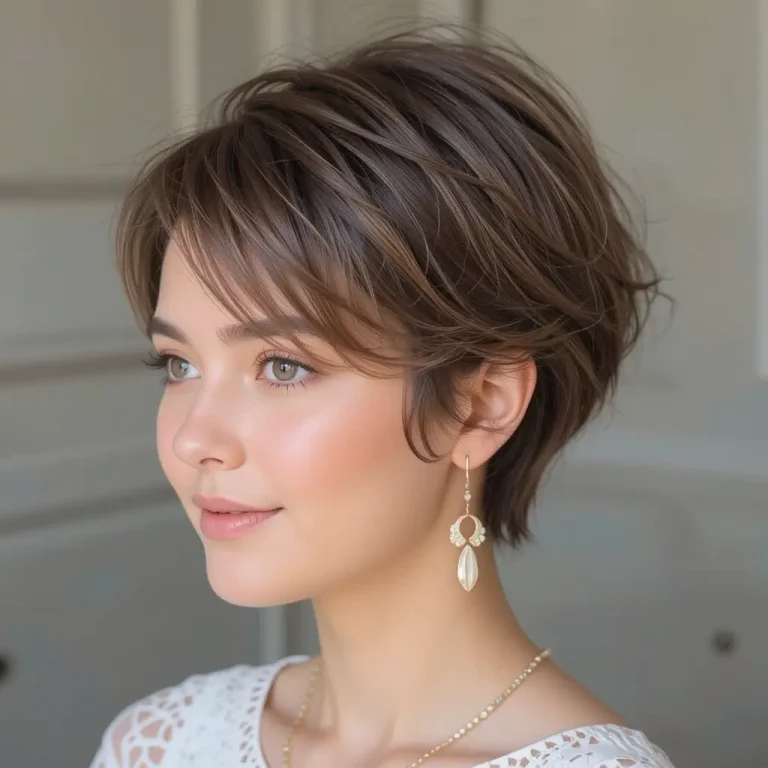
A short shag haircut is a layered cut, usually between 2 and 7 inches long, with shorter, choppy layers concentrated at the crown and around the face and lighter, piece-y ends. The layers are cut to create movement and lift rather than a smooth, one-length line, which is why shags look tousled even when barely styled.
The difference from a regular layered bob is where the weight lives. A classic bob keeps weight at the perimeter for a solid edge. A shag pulls weight up and out of the interior, so the top has height and the ends look feathery. Stylists typically use point cutting, slide cutting, or a razor to soften the ends.
For women over 50, that structure solves two common changes: hair often gets finer at the crown, and gray strands can be wirier and more resistant. Shag layers turn both into texture instead of a problem.
20 Short Shag Haircuts for Women Over 50 with Glasses
1. Feathered Pixie Shag with a Lifted Crown

The shortest shag on the list keeps the sides close to the head and lets the crown carry about 2 to 3 inches of feathered layers. With glasses, that tight perimeter is the selling point: nothing gets caught under your temple arms, and the height on top balances bolder frames like thick acetate or cat-eye shapes. Fine hair gets the most benefit, since short layers stand up more easily than long ones. Style by rough-drying with your fingers, then twisting a pea-size amount of texture paste into the crown.
Best for: fine to medium straight or slightly wavy hair
- Length: 1.5–3 inches
- Maintenance: Medium
- Styling time: 5–10 min
- Trim every: 4–6 weeks
- Color touch-up: 4–6 weeks for root coverage
2. Silver Pixie Shag with a Tapered Nape

Natural silver hair has a cool, reflective quality that looks best when the cut is crisp. This version tapers the nape and sides with clippers or shears, then leaves soft, uneven pieces on top that fall forward toward the forehead.
Pair it with clear, metallic, or icy-blue frames and the whole look reads modern rather than “grown out.” Coarse gray strands help here; their wiry texture holds the choppy pieces without much product. A purple shampoo once a week keeps yellow tones out of the silver.
Best for: coarse or medium gray hair, straight to slightly wavy
- Length: 1–3 inches
- Maintenance: Low
- Styling time: 5 min
- Trim every: 4–5 weeks
- Color touch-up: Not needed with natural silver
3. Coily Tapered Shag

On Type 4 coils, a shag is built by shaping rather than slicing. The sides and nape are tapered short, while the top keeps 2 to 4 inches of coils shaped into a rounded, slightly higher silhouette. That taper keeps volume away from the ears, so glasses sit flat, and the rounded crown lifts the eye line. Define coils with a leave-in conditioner followed by a curl custard or gel, finger-coiling a few sections in front for definition. Moisture matters more after 50, so seal with a light oil.
Best for: Type 4A–4C coily hair, medium to thick density
- Length: 1–4 inches
- Maintenance: Medium
- Styling time: 10–15 min
- Trim every: 6–8 weeks
- Color touch-up: 6–8 weeks if using semi-permanent color
4. Choppy Pixie Shag with a Side-Swept Fringe

A long, diagonal fringe swept across one side breaks up the horizontal line of your frames. The rest of the cut stays short and textured, with visible, separated ends that look intentionally undone. Because the fringe angles away from the lenses rather than hanging over them, it works with wide or oversized glasses that would crowd a straight bang. Medium density straight hair shows off the choppy texture best. Blow-dry the fringe in the direction you want it to fall, then pinch the ends with a matte pomade.
Best for: medium-density straight hair
- Length: 2–4 inches
- Maintenance: Medium
- Styling time: 10 min
- Trim every: 5–6 weeks
- Color touch-up: 4–6 weeks for root coverage
5. Micro Fringe Pixie Shag

A short, piece-y fringe cut about halfway down the forehead sits well above any frame, so it never touches your lenses or rim. That makes it one of the few bang styles that pair easily with heavy or tall frames.
The overall feel is a little gamine and a little bold, especially on straight hair, which shows the cut lines clearly. Cowlicks at the hairline can make micro-fringes stand up, so check yours before committing. Style with a flat brush and a touch of smoothing cream.
Best for: straight, medium to thick hair without a strong front cowlick
- Length: 1.5–3 inches
- Maintenance: High
- Styling time: 10 min
- Trim every: 4 weeks (fringe every 2–3 weeks)
- Color touch-up: 4–6 weeks for root coverage
6. Curly Pixie Shag

Type 3 curls turn short shag layers into a halo of springy texture. The cut keeps about 3 to 4 inches on top so curls can form full loops, while the sides are shorter and shaped close enough to sit neatly under your temple arms.
Curls naturally lift the crown, which is helpful if you’re seeing thinning there. Cutting dry, curl by curl, gives the most predictable shape. Scrunch in a lightweight mousse on soaking-wet hair and diffuse on low heat.
Best for: Type 3A–3C curls, fine to medium density
- Length: 2–4 inches
- Maintenance: Medium
- Styling time: 15 min
- Trim every: 6–8 weeks
- Color touch-up: 6–8 weeks for root coverage
7. Ear-Length Shag with Tuck-Behind Sides

Designed specifically for glasses wearers, this cut leaves the side sections just long enough to tuck behind the ear and over the temple arms. The tucked pieces stay put instead of sliding forward, and the rest of the shag keeps loose, tousled layers through the crown and back.
It’s a clever choice if you take your glasses on and off all day, since nothing gets pulled or tangled. Ask for thinned-out sides so the tuck sits flat. Smooth the sides with a little cream and rough up the top.
Best for: medium-density straight or wavy hair
- Length: 3–4 inches
- Maintenance: Low
- Styling time: 5–10 min
- Trim every: 6 weeks
- Color touch-up: 4–6 weeks for root coverage
8. Shaggy Bob with Curtain Bangs

Curtain bangs part in the center and sweep away from the eyes, so they frame your glasses rather than covering them. Here they’re paired with a chin-length shag that has soft, bendy layers around the jaw.
The arc of the bangs draws attention to the cheekbones, which flatters most frame shapes, from rectangular to round. Have the bangs cut long enough to clear the top of your frames, typically at or just below the brow. Round-brush the bangs back and away, then flex the ends with a texture spray.
Best for: fine to medium straight or wavy hair
- Length: 4–6 inches
- Maintenance: Medium
- Styling time: 10–15 min
- Trim every: 6–8 weeks (bangs every 4 weeks)
- Color touch-up: 4–6 weeks for root coverage
9. Stacked Shag Bob for Fine Hair

Stacking means the back is graduated shorter at the nape and builds upward, creating a natural lift at the crown, which is exactly where fine hair over 50 tends to go flat. Shag layering through the front keeps the look relaxed instead of formal.
The ends at the jaw stay fairly solid so fine strands don’t look wispy or see-through. Lighter frames, like thin metal or rimless styles, keep the look proportional. Blow-dry with a volumizing mousse and lift the crown with a round brush.
Best for: fine, thinning, straight hair
- Length: 2–5 inches
- Maintenance: Medium
- Styling time: 10–15 min
- Trim every: 6 weeks
- Color touch-up: 4–6 weeks for root coverage
10. Wavy Chin-Length Shag with Bottleneck Bangs

Bottleneck bangs are narrow at the top and widen as they fall, curving around the eyes like an hourglass. With glasses, that shape opens the center of the face and lets the bangs bend around the outer edges of your frames.
Natural waves add an easy, beachy movement through the chin-length layers. Air-dry with a sea salt spray or wave cream, then use a flat iron to bend only the bangs outward. Frames with a rounded top line echo the curve beautifully.
Best for: Type 2A–2C wavy hair, medium density
- Length: 4–6 inches
- Maintenance: Medium
- Styling time: 10 min
- Trim every: 6–8 weeks
- Color touch-up: 3–4 months with highlights
11. The Soft “Shob” with a Fuller Perimeter

The shob blends a shag with a bob: choppy interior layers paired with a denser outline at the chin. That fuller perimeter helps if your ends have thinned, because it keeps the bottom of the haircut from looking stringy.
It’s a smart compromise if you want texture without the full shag tousle. The extra fullness at the jaw also balances heavier or wider frames. Rough-dry, then use a flat iron to put a slight outward bend in the ends.
Best for: fine to medium hair with thinning ends, straight or slightly wavy
- Length: 4–6 inches
- Maintenance: Low
- Styling time: 10 min
- Trim every: 6–8 weeks
- Color touch-up: 4–6 weeks for root coverage
12. Asymmetrical Side-Part Shag

A deep side part with one side slightly longer than the other creates an angle that plays nicely against strong, straight-edged frames. The longer side falls just past the cheek, while the shorter side clears the ear and the temple arm.
That asymmetry gives the cut more personality than a center-part shag. Medium to thick hair holds the shape best. Flip the part to the side opposite your usual one to add instant lift at the root, then finish with a flexible-hold hairspray.
Best for: medium to thick straight hair
- Length: 3–6 inches
- Maintenance: Medium
- Styling time: 10 min
- Trim every: 6 weeks
- Color touch-up: 4–6 weeks for root coverage
13. Salt and Pepper Shag with Gray Blending

If you’re transitioning from dyed hair to natural gray, shag layers are forgiving: the uneven, choppy pieces disguise the line between old color and new growth. A colorist can add fine babylights or lowlights to blend the two, so the overall effect is a soft salt and pepper mix rather than a stark demarcation. Silver, gunmetal, or black frames tie the tones together. Use a color-safe shampoo for the blended pieces and a gloss every couple of months for shine.
Best for: medium-density straight or wavy hair transitioning to gray
- Length: 3–5 inches
- Maintenance: Medium
- Styling time: 10 min
- Trim every: 6 weeks
- Color touch-up: 3–4 months for blending lights
14. Curly Chin-Length Shag Bob

Longer than the curly pixie, this version gives Type 3 curls room to form fuller ringlets around the jaw. The top layers are cut shorter so the crown doesn’t flatten under the weight of the curls, which prevents the triangle shape that often happens with one-length curly bobs. Curls near the temples should be shaped to rest behind your frame arms. Apply a curl cream and gel on wet hair, scrunch, diffuse, and then “scrunch out the crunch” once dry.
Best for: Type 3A–3B curls, medium to thick density
- Length: 4–7 inches
- Maintenance: Medium
- Styling time: 15–20 min
- Trim every: 8–10 weeks
- Color touch-up: 6–8 weeks for root coverage
15. Mod Shag with Full Brow-Length Bangs

Inspired by 1960s and 1970s rock styling, the mod shag combines full, straight bangs with layered sides. For glasses, the key is the bang length: it should land just at or slightly above your brows, so the bottom edge sits above your frames rather than resting on the rim.
This one works best with thinner frames, since heavy frames plus full bangs can feel crowded. Straight, medium-thick hair keeps the bang edge clean. Blow-dry the bangs flat with a paddle brush.
Best for: straight, medium to thick hair
- Length: 3–6 inches
- Maintenance: High
- Styling time: 15 min
- Trim every: 6 weeks (bangs every 3 weeks)
- Color touch-up: 4–6 weeks for root coverage
16. Razor-Cut Shag for Thick Hair

A razor slices into the ends at an angle, removing bulk and leaving feathery, tapered tips. On thick hair, that makes the difference between a shag that moves and one that puffs out like a helmet. Removing weight around the ears also means your glasses won’t get pushed forward by dense hair behind them. The finished look is airy and very textured. Razor cuts can fray on fragile or very curly hair, so this suits healthy, straight to slightly wavy strands best. Finish with a light texturizing spray.
Best for: thick, coarse, straight to slightly wavy hair
- Length: 3–6 inches
- Maintenance: Medium
- Styling time: 10 min
- Trim every: 6 weeks
- Color touch-up: 4–6 weeks for root coverage
17. Soft Neck-Length Mullet Shag

This is the gentle, grown-up take on the modern mullet: shorter, choppy layers on top and around the face, with longer, piece-y lengths at the nape. The contrast is subtle rather than dramatic, so it looks edgy but wearable.
Shorter sides keep the area around your temple arms tidy, while the longer back softens the overall shape. It suits wavy hair especially well, since the waves blur the transition between lengths. Scrunch in wave spray and air-dry.
Best for: Type 2 wavy hair or straight hair with natural bend, medium density
- Length: 3–7 inches
- Maintenance: Medium
- Styling time: 10 min
- Trim every: 6–8 weeks
- Color touch-up: 3–4 months with highlights
18. Warm Copper Shag with Face-Framing Pieces

A warm copper tone adds instant vibrancy, especially against tortoiseshell, honey, or gold frames. The cut is a chin-length shag with brighter face-framing pieces painted around the front, which put the most color near the eyes.
Copper suits warm and neutral undertones most naturally; cooler skin tones may prefer a deeper auburn. Red pigments fade faster than most shades, so use a color-depositing conditioner weekly and wash in cool water. A gloss between appointments keeps the shine.
Best for: medium-density straight or wavy hair, warm or neutral skin undertones
- Length: 4–6 inches
- Maintenance: High
- Styling time: 10–15 min
- Trim every: 6–8 weeks
- Color touch-up: 6–8 weeks (gloss every 4 weeks)
19. Coily Shag Bob

Longer than the tapered coily shag, this bob-length version keeps 4 to 7 inches of coils shaped into graduated layers, with the shortest pieces at the crown and longer coils toward the jaw. The result is a rounded, airy shape with movement, rather than the boxy outline one-length coily cuts can take on.
Shaping the sides narrower near the temples helps your glasses rest flat. Define with a leave-in, then a gel or curling cream applied in sections. Refresh mid-week with a water-and-leave-in spray.
Best for: Type 4A–4B coils, medium to thick density
- Length: 4–7 inches
- Maintenance: Medium
- Styling time: 20–30 min
- Trim every: 8–10 weeks
- Color touch-up: 6–8 weeks if using semi-permanent color
20. Collar-Length Shag with Flipped Ends

The longest cut here falls to the collar, with a flip at the ends that adds a polished, slightly retro finish. Layers through the crown and face keep it unmistakably a shag, while the length gives you options: tuck it behind your ears, pin it up, or wear it full. It’s a comfortable choice if you’re not ready to go very short. Medium to thick hair holds the flip best. Use a round brush or a large flat iron to curve the ends outward.
Best for: medium to thick straight hair
- Length: 6–8 inches
- Maintenance: Medium
- Styling time: 15 min
- Trim every: 8 weeks
- Color touch-up: 4–6 weeks for root coverage
How Do I Choose the Right Short Shag If I Wear Glasses?
Choose a short shag by matching it to three things: your frames, your hair density, and your styling time. Heavy or tall frames pair best with shorter fringes or side-swept bangs; thin or rimless frames can handle fuller bangs. Fine hair needs crown layers with solid ends, while thick hair needs weight removed.
Start with your frames. Look at the top line of your glasses. Bangs should either clear it with space to spare (micro-fringe, curtain bangs cut above the brow) or angle away from it (side-swept). A bang that rests on the rim will separate, smudge your lenses, and look heavy.
Then consider your ears. Temple arms sit right where side layers fall. Either keep the sides short and tapered, or keep them long and light enough to tuck. Thick, mid-length bulk over the ears is the one combination to avoid.
Factor in color and undertone. Warm frames (tortoiseshell, gold, honey) look harmonious with copper, caramel, and golden blonde. Cool frames (silver, black, clear, blue) complement natural silver, ash tones, and salt-and-pepper.
Be honest about time. If you want to be out the door in 5 minutes, choose the silver pixie, ear-length tuck shag, or shob. Bangs, bright color, and curl definition add time and appointments.
Which Short Shag Works Best for Fine, Thick, Wavy, Curly, or Coily Hair?
The best short shag depends on how your hair holds layers. Fine hair needs fewer, shorter layers at the crown with denser ends; thick hair needs internal weight removed; waves and curls need layers cut to their natural pattern so the shape doesn’t collapse or triangle out.
- Fine or thinning hair: Too many layers make fine hair look sparse. A stacked shag, feathered pixie, or shob keeps the crown lifted while leaving enough density at the ends to look full.
- Thick hair: Dense hair expands sideways when layered without thinning. Razor cutting, slide cutting, or interior texturizing lets it move, and reduces the bulk that pushes against glasses.
- Wavy hair (Type 2): Waves get heavier as they get longer, which can drag them straight. Shag layers lighten the load so the bend returns, especially in bottleneck-bang and soft mullet shags.
- Curly hair (Type 3): Curls shrink, often by several inches, so cutting dry shows where each curl actually lands. Shorter top layers prevent the flat-top, wide-bottom triangle.
- Coily hair (Type 4): Coils have the most shrinkage and the most fragility. Shaping and tapering, rather than heavy razor work, protects the ends while building a rounded shape.
How Do I Care for a Short Shag at Home?
A short shag needs moisture, light products, and quick, targeted styling. Most over-50 hair is drier than it used to be, so a gentle shampoo, regular conditioning, and heat protection do more for the shape than heavy styling products.
- Wash 2–3 times a week with a sulfate-free, color-safe shampoo. Gray and color-treated hair both lose moisture quickly.
- Condition every wash, focusing on mid-lengths and ends. Use a deep-conditioning mask weekly if your hair feels rough.
- Apply heat protectant before any blow-drying, flat ironing, or curling.
- Use one styling product, sparingly. Texture paste for pixies, mousse for fine hair, curl cream or gel for curls and coils, wave spray for Type 2 hair.
- Refresh on day two with dry shampoo at the roots (straight and wavy) or a water-and-leave-in mist (curls and coils).
- Gloss every 4–8 weeks if you color or want shine on natural gray; purple shampoo once a week keeps silver from turning brassy.
- Clean your glasses after styling. Hairspray and oils drift onto lenses; style first, then put your frames on.
FAQ: Short Shag Haircuts for Women Over 50
Are short shag haircuts good for women over 50?
Yes, short shags suit many women over 50 because the crown layers add lift where hair often thins with age. The choppy texture also works with coarse gray strands rather than against them. Results depend on density and texture, so the layering should be adjusted for fine versus thick hair.
Can I wear bangs with a short shag and glasses?
You can wear bangs with glasses as long as they don’t rest on your frames. Curtain bangs, side-swept bangs, and micro-fringes work well because they either clear the top rim or angle away from the lenses. Full bangs are best with thin frames and should be cut at or just above the brows.
Do shag haircuts make thin hair look thinner?
A well-cut shag makes thin hair look fuller, but too many layers can make it look sparse. Fine hair needs short layers concentrated at the crown, with the ends kept fairly solid. Stacked shags and shobs are reliable choices for thinning hair.
How often should I trim a short shag?
Trim a pixie-length shag every 4–6 weeks and a chin- to neck-length shag every 6–8 weeks. Curly and coily shags can usually go 8–10 weeks. Bangs need a quick trim every 2–4 weeks to keep them off your frames.
What is the most low-maintenance short shag for women over 50?
The silver pixie shag with a tapered nape is one of the lowest-maintenance options, needing about 5 minutes of styling and no color appointments. The ear-length tuck shag and the soft shob are also quick to style. Avoid full bangs and bright color if minimal upkeep is the goal.
Can you get a shag haircut with curly or coily hair?
Yes, curly and coily hair can hold a shag beautifully when the cut is shaped to the natural curl pattern. Many stylists cut curls dry so they can see how each section shrinks. Shorter top layers prevent the triangle shape common in one-length curly cuts.
Should my hair cover my ears if I wear glasses?
Your hair can cover your ears, but it should be light enough to tuck behind them or sit smoothly over the temple arms. Thick, bulky hair over the ears tends to push glasses forward and tangle in the frames. Tapered sides or thinned-out side sections solve the problem.
What color frames look best with gray hair?
Cool and contrasting frames often look striking with gray hair, including black, gunmetal, clear, navy, and jewel tones like burgundy or teal. Tortoiseshell softens silver hair and adds warmth. The best choice depends on your skin undertone and how much contrast you want.
Finding Your Shag
If you want the easiest morning, start with the silver pixie shag or the ear-length tuck shag. If your hair is fine and flat at the crown, book a stacked shag bob or a feathered pixie. Thick hair calls for a razor-cut shag, curls and coils for a dry-cut curly or coily shag, and anyone who loves bangs with glasses should try curtain or side-swept versions first.
Save your favorites from this list to a Pinterest board so you can compare them side by side with your frames. For more cuts, color ideas, and texture guides built around real hair, explore the rest of Hairstyle Inspirations