

20 Low Maintenance Short Shag Hairstyles with Bangs for Busy Mornings

You want hair that looks intentional at 7:40 a.m. when you have exactly ten minutes, a cold coffee, and no patience for a round brush. Short shag hairstyles with bangs solve that problem better than most cuts. Their layers are designed to look slightly undone, so a bit of frizz, a flat spot, or an air-dried bend reads as texture instead of a mistake. The bangs carry most of the visual impact, which means you often only need to style the front.
The catch is that not every shag behaves well on every head of hair. At Hairstyle Inspirations, we sorted these 20 cuts by length and texture. Each one includes realistic trim schedules, styling times, and color upkeep, so you can pick a shag that fits your hair and your mornings.
Quick Overview: Which Short Shag with Bangs Fits You?
- Lowest maintenance overall: A shag with grown-out curtain bangs. The fringe blends into face-framing layers and tolerates 10–12 weeks between cuts.
- Best for fine hair: A bixie shag or ear-length shag with light, wispy bangs. Fewer, shorter layers keep the ends from looking thin.
- Best for thick hair: A choppy shag with internal texturizing or an undercut nape, which removes bulk so the shape doesn’t puff out.
- Best for curls and coils: A curly or coily shag cut dry, curl by curl, with rounded bangs cut at their natural shrunken length.
- Trim frequency: Most short shags need a full cut every 6–10 weeks. Bangs need a trim every 3–5 weeks unless they’re curtain-style.
- Color touch-up timing: Lived-in color, root smudges, and gray blending stretch to 3–5 months. Bright copper and all-over color usually need a gloss every 6–8 weeks.
What Is a Short Shag Haircut with Bangs?
A short shag haircut with bangs is a layered cut, usually between pixie and shoulder length, with choppy, graduated layers concentrated at the crown and around the face, paired with a fringe. The layers create built-in volume and movement. The bangs, from wispy to blunt to curtain-style, frame the eyes and cheekbones.
The shag differs from a layered bob because the layers start higher, often at the crown, and the ends are deliberately uneven. A bob keeps weight at the perimeter. A shag pulls weight up and out. That shift matters for busy mornings: once the weight sits at the top, the cut holds its shape from texture alone, without heat styling.
Stylists cut shags with a razor, point-cutting shears, or, for curls, dry cutting. Razor-cut layers look softer and more feathered on straight and wavy hair. Point-cut layers hold up better on fine hair, where a razor can leave ends looking wispy and frayed.
20 Short Shag Hairstyles with Bangs, Shortest to Longest
1. Pixie Shag with Wispy Micro-Fringe

The shortest shag on this list keeps 1–2 inches on the sides and slightly more at the crown, with a feathery fringe that stops well above the brows. Choppy crown layers do the work a blow-dryer would, so morning styling often means a pea-sized bit of matte paste rubbed through dry hair.
On fine, straight hair, the piecey crown adds visual density. On thick hair, ask your stylist to thin the back so it doesn’t mushroom out. A micro-fringe draws attention to the eyes and brows, so it tends to flatter oval and heart-shaped faces with defined features.
Best for: Fine to medium, straight hair
- Length: 2–4 inches
- Maintenance: Medium
- Styling time: 5 min
- Trim every: 4–6 weeks
- Color touch-up: Not needed for natural color; 6–8 weeks for single-process color
2. Curly Pixie Shag with Coily Fringe

Tight curls and coils form a sculpted crown here, while the sides stay close to the head and the curls fall forward into a soft, springy fringe. Because Type 4 hair can shrink up to 75% of its stretched length, the bangs should be cut dry and at their natural curled length.
Wash days get shorter with this cut: apply a leave-in conditioner and a curl cream to soaking-wet hair, then air-dry or diffuse. Mornings usually need only a spritz of water and a fingertip fluff at the roots.
Best for: Type 4A–4C coils, medium to thick density
- Length: 2–5 inches (stretched)
- Maintenance: Low
- Styling time: 5 min
- Trim every: 6–8 weeks
- Color touch-up: Not needed for natural color; 8–10 weeks for honey or copper rinses
3. Textured Mixie Shag with Side-Swept Bangs

The mixie blends a pixie’s tight sides with a mullet’s slightly longer nape, softened by shaggy layers and a long fringe swept to one side. The longer back gives you something to tuck behind your ear, and the side-swept bangs grow out gracefully because they’re already angled.
Thick, straight hair handles this cut best, since density keeps the nape from looking stringy. Rough-dry with your fingers, then twist a few front pieces with a texture spray for separation.
Best for: Medium to thick, straight or slightly wavy hair
- Length: 2–6 inches
- Maintenance: Medium
- Styling time: 7 min
- Trim every: 5–7 weeks
- Color touch-up: Not needed for natural color; 6–8 weeks for all-over color
4. Ear Length Shag with Baby Bangs

Baby bangs sit a half inch or more above the brows and give this cut its bold, editorial edge. The perimeter falls around the earlobes, with tight layers stacked through the crown. Cowlicks are the main concern: a strong hairline swirl can make very short bangs stand straight up, so ask your stylist to check your growth pattern before cutting. On straight hair, the look is crisp and graphic. On wavy hair, the bangs curl slightly and soften the effect.
Best for: Fine to medium, straight hair without strong front cowlicks
- Length: 4–6 inches
- Maintenance: Medium
- Styling time: 5 min
- Trim every: 6 weeks (bangs every 3 weeks)
- Color touch up: Not needed for natural color; 6–8 weeks for single-process color
5. Bixie Shag with Feathered Bangs

The bixie sits between a bob and a pixie, covering the ears with soft, feathered layers and bangs that blend into the sides. It works especially well on fine hair, because the shorter length keeps the ends looking full while the layers add lift at the crown.
Blow-dry upside down for 2–3 minutes, then flip back and scrunch with a light mousse. The feathered fringe falls into place on its own and rarely needs a flat iron.
Best for: Fine to medium, straight to slightly wavy hair
- Length: 4–7 inches
- Maintenance: Low
- Styling time: 8 min
- Trim every: 6–8 weeks
- Color touch-up: Not needed for natural color; 8–10 weeks for highlights
6. Silver Blended Bixie Shag with Side Bangs

If you’re growing out gray, this cut helps. Choppy layers break up the line where natural silver meets old color, and gray blending, meaning fine lowlights and highlights woven near the roots, softens the contrast further.
The side bangs hide the hairline, which is where regrowth shows first. Gray hair is often coarser and drier, so a purple shampoo once a week and a lightweight smoothing cream keep the texture from looking frizzy or yellow.
Best for: Gray, silver, or salt-and-pepper hair, medium to coarse texture
- Length: 4–7 inches
- Maintenance: Low
- Styling time: 8 min
- Trim every: 6–8 weeks
- Color touch-up: 3–4 months for gray blending; none once fully grown out
7. Mod Shag with Full Eyebrow-Length Fringe

This is the 1970s rock-and-roll version: a heavy, full fringe that skims the brows, chunky crown layers, and a rounded silhouette. The fringe is denser than most on this list, so it suits medium to thick hair that can hold a weighted bang without separating.
Blow-dry the fringe forward with a flat brush for one minute, and let the rest air-dry. The bangs grow into your eyes quickly, which makes this the highest-upkeep style here, though daily styling stays fast.
Best for: Medium to thick, straight hair
- Length: 6–9 inches
- Maintenance: Medium
- Styling time: 8 min
- Trim every: 6–8 weeks (bangs every 3 weeks)
- Color touch-up: Not needed for natural color; 6–8 weeks for all-over color
8. Chin Length Shag with Curtain Bangs

Curtain bangs part in the center and sweep outward toward the cheekbones, and they’re the most forgiving fringe for busy mornings. On a chin-length shag with Type 2 waves, the layers bend in different directions to create soft, natural volume.
Apply a wave cream to damp hair and air-dry, or blow-dry just the bangs with a round brush for 90 seconds. As the curtain bangs grow, they become face-framing layers, so a missed trim won’t show.
Best for: Type 2A–2C waves, fine to medium density
- Length: 7–9 inches
- Maintenance: Low
- Styling time: 8 min
- Trim every: 8–10 weeks
- Color touch-up: Not needed for natural color; 3–4 months for balayage
9. Italian Inspired Shag Bob with Soft Fringe

This cut keeps more weight at the perimeter than a classic shag, so it reads as a full, plush bob with shaggy movement through the middle and ends. The soft fringe is slightly longer at the edges, which blends it into the sides.
Thick, straight, or slightly wavy hair gives it that bouncy, expensive look. A blow-dry with a large round brush takes about 12 minutes, but on rushed days, air-drying with a smoothing balm still leaves a polished shape.
Best for: Thick, straight to wavy hair
- Length: 7–10 inches
- Maintenance: Low
- Styling time: 12 min
- Trim every: 8 weeks
- Color touch-up: Not needed for natural color; 8–10 weeks for gloss
10. Type 3 Curly Shag with Rounded Bangs

Curly shags work best when each curl is cut in its natural pattern, usually dry, so the stylist can see where every ringlet lands. The result is a rounded, halo-like shape with curly bangs that frame the forehead without hiding it. Type 3A–3C curls add volume at the crown on their own. On wash day, use a leave-in, curl cream, and a light gel, then diffuse on low heat. Between washes, refresh with a water-and-leave-in mist.
Best for: Type 3A–3C curls, medium to thick density
- Length: 6–10 inches (stretched)
- Maintenance: Low
- Styling time: 10 min (refresh days); 30 min (wash days)
- Trim every: 10–12 weeks
- Color touch-up: Not needed for natural color; 3–4 months for curl-friendly highlights
11. Chin Length Coily Shag with Picked Out Fringe

For Type 4 hair that’s grown past the pixie stage, this shag shapes coils into a tapered, layered silhouette that’s fuller at the crown and slightly narrower at the nape. The fringe is picked out with a wide-tooth pick for soft height.
Moisture is the priority: use the LOC method (liquid, oil, cream), then define with finger coils or a twist-out on wash day. The shape lasts several days, and a satin bonnet or pillowcase protects the definition overnight.
Best for: Type 4A–4C coils, medium to thick density
- Length: 6–10 inches (stretched)
- Maintenance: Medium
- Styling time: 10 min (refresh); 45 min (wash day)
- Trim every: 8–12 weeks
- Color touch-up: Not needed for natural color; 8–12 weeks for semi-permanent rinses
12. Copper Chin Length Shag with Curtain Bangs

A warm copper shade makes the layers look deeper because light catches the piecey ends differently than the roots. Copper flatters many warm and neutral undertones, though very cool, rosy undertones may prefer a softer strawberry-copper.
Red pigment fades faster than other shades, so this is the highest-color-maintenance pick. Wash in cool water, use a color-safe sulfate-free shampoo, and add a copper color-depositing conditioner once a week to stretch time between salon visits.
Best for: Medium to thick, straight or wavy hair with warm or neutral undertones
- Length: 7–10 inches
- Maintenance: Medium
- Styling time: 8 min
- Trim every: 8 weeks
- Color touch-up: Gloss every 6–8 weeks; roots every 8–10 weeks
13. Choppy Short Wolf-Cut Shag

A cousin of the shag, the wolf cut uses more aggressive layering at the crown and a choppier fringe for a slightly edgier look. This shorter version stops at the jaw, making it easier to manage than a long wolf cut.
Thick hair benefits most because heavy texturizing removes bulk and keeps the shape from becoming triangular. Mornings mean a sea salt spray on damp hair, a quick rough-dry, and a few twisted pieces at the front.
Best for: Thick, straight to wavy hair
- Length: 8–11 inches
- Maintenance: Low
- Styling time: 7 min
- Trim every: 8–10 weeks
- Color touch-up: Not needed for natural color; 3–4 months for lived-in highlights
14. Air-Dry Wavy Jaw Shag with Eyebrow-Skimming Bangs

This style has one goal: skip the blow-dryer. Waves are cut to fall along the jaw, and the bangs are kept slightly long, at the brow or just below, so they bend naturally instead of springing up. Scrunch a lightweight mousse into soaking-wet hair, plop it in a cotton T-shirt for 10 minutes, then let it dry. If the bangs kink oddly, wet just the fringe and press it flat with your fingers for a minute.
Best for: Type 2B–2C waves, medium density
- Length: 8–11 inches
- Maintenance: Low
- Styling time: 5 min (plus air-dry time)
- Trim every: 8–10 weeks
- Color touch-up: Not needed for natural color; 3–4 months for babylights
15. Undercut Nape Shag with Long Bangs
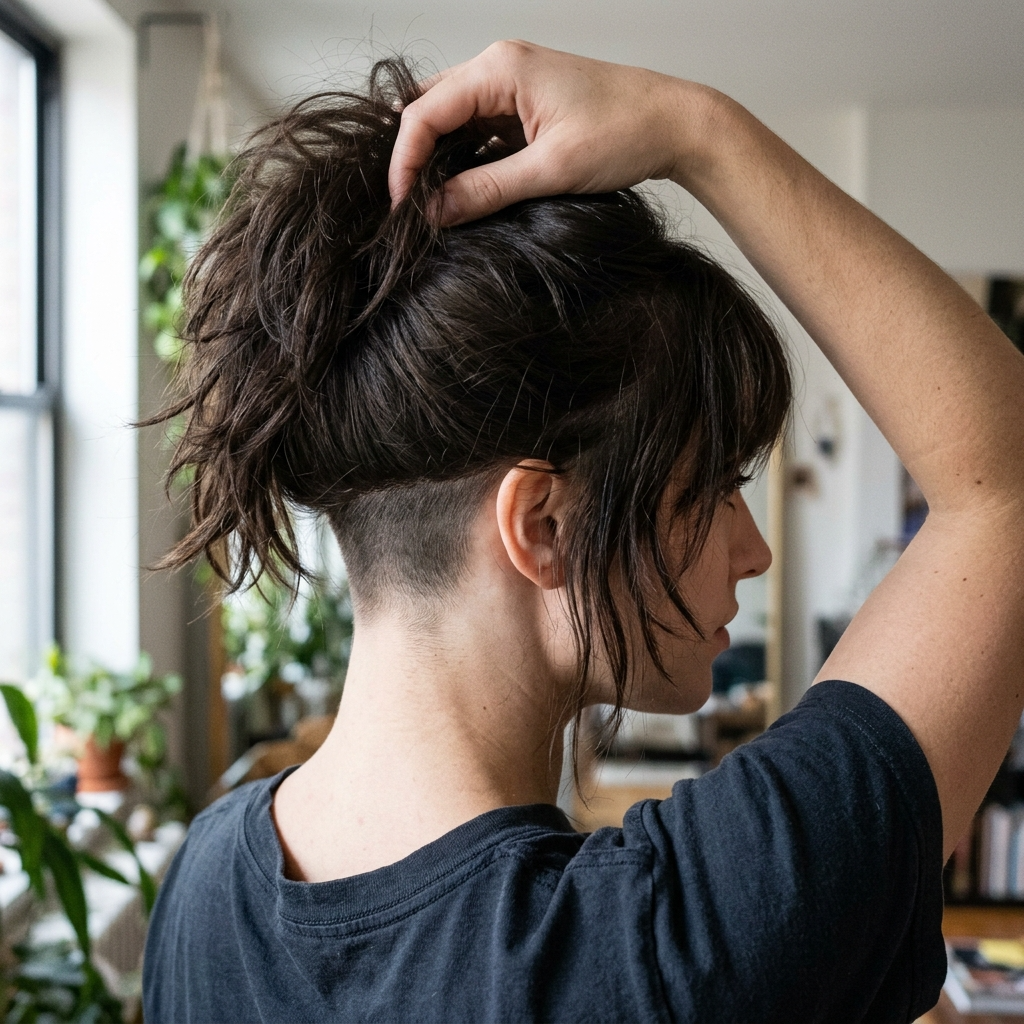
Very thick hair can make any short cut feel heavy and hot. A hidden undercut at the nape removes that bulk underneath, while the top layers and long, piecey bangs stay full. The undercut stays invisible unless you wear your hair up, which makes for a cooler, lighter ponytail. Air-dry with a light cream for most days. The buzzed section needs a clean-up every 4–6 weeks, but the shag layers can go longer.
Best for: Very thick or coarse, straight to wavy hair
- Length: 8–12 inches (top layers)
- Maintenance: Medium
- Styling time: 7 min
- Trim every: 8–10 weeks (undercut every 4–6 weeks)
- Color touch-up: Not needed for natural color; 8–10 weeks for single-process color
16. Sandy Blonde Lived-In Shag with Root Smudge

A root smudge, meaning a shade close to your natural color blended a few inches down from the scalp, softens the transition between roots and lighter ends. On a shag, it adds depth at the crown and lets the brighter sandy-blonde ends highlight the layering.
The wispy bangs keep it airy. This is one of the easiest color schedules here, because regrowth blends rather than leaving a hard line. A purple or blue toning shampoo every two weeks keeps brassiness down.
Best for: Fine to medium, straight to wavy hair with a light brown or dark blonde base
- Length: 9–12 inches
- Maintenance: Low
- Styling time: 10 min
- Trim every: 8–10 weeks
- Color touch-up: 4–5 months (toner/gloss every 8–10 weeks)
17. Mahogany Shag with Face Framing Ribbon Highlights
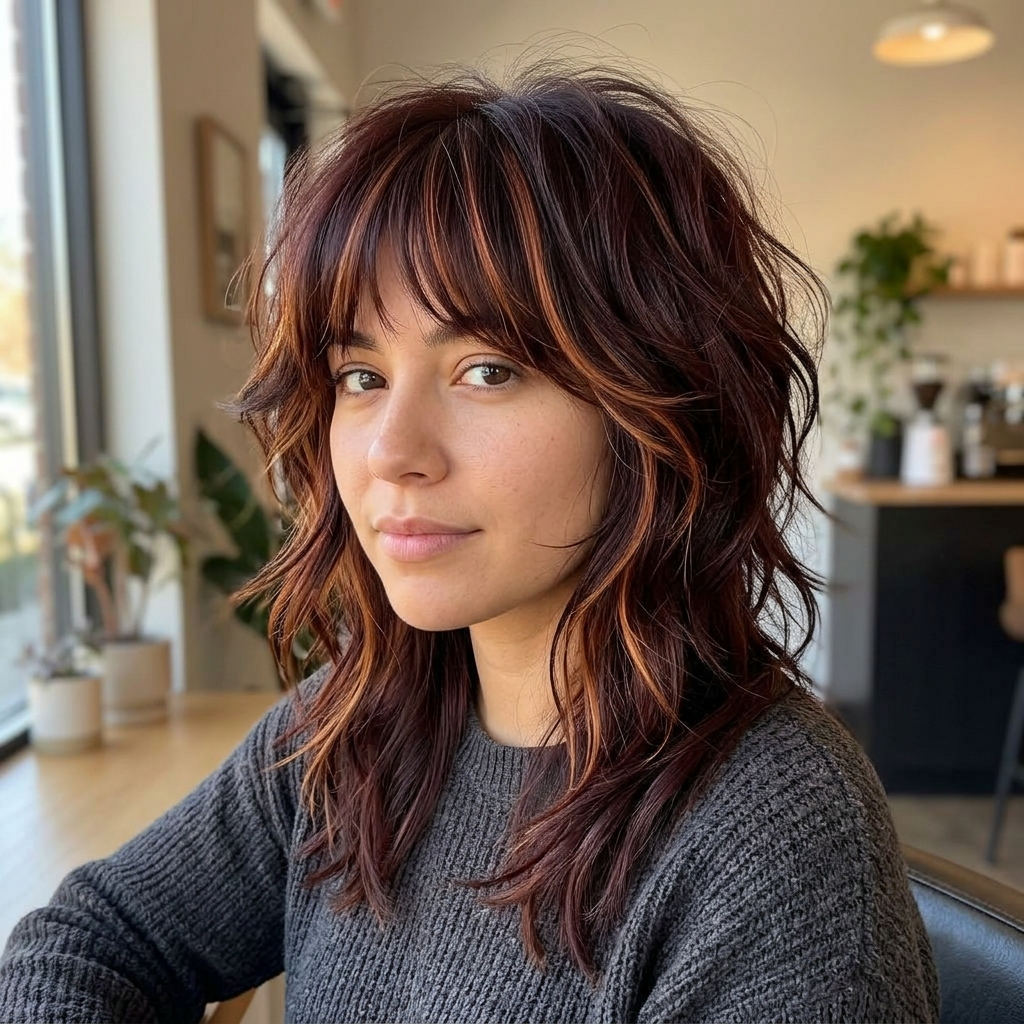
Ribbon highlights are thin, deliberate streaks placed near the face and along the bangs, rather than painted throughout. Against a deep mahogany base, the contrast catches the light when the shag layers move.
Because the highlights sit only at the front, regrowth is less noticeable than with a full foil. Brunettes with warm or neutral undertones tend to suit caramel or cinnamon ribbons, while cooler undertones may prefer a mushroom-brown tone.
Best for: Medium to thick, straight or wavy brunette hair
- Length: 9–12 inches
- Maintenance: Medium
- Styling time: 10 min
- Trim every: 8 weeks
- Color touch-up: 3–4 months (gloss at 8 weeks)
18. Shag with Grown Out Curtain Bangs

The lowest-maintenance cut on this list is built around bangs that have already been allowed to grow. They fall to the cheekbones or lips and blend into the face-framing layers. You get the softness of a fringe without the trims.
Tuck them behind your ears on hectic days, or blow-dry them outward for 60 seconds when you want more shape. It’s also a smart choice if you’re testing bangs for the first time and want an easy exit.
Best for: Fine to thick, straight to wavy hair
- Length: 9–12 inches
- Maintenance: Low
- Styling time: 5 min
- Trim every: 10–12 weeks
- Color touch-up: Not needed for natural color; 3–5 months for balayage
19. Fine Hair Shoulder Shag with Split Curtain Bangs

Longer shags can make fine hair look thin at the ends, so this cut uses fewer, longer layers and keeps the perimeter blunt for density. The split curtain bangs part in the middle and stay light, so they don’t eat into the hair you need around the face.
Volumizing mousse at the roots and a quick blow-dry with your head flipped give the crown lift. Skip heavy oils and creams, which flatten fine strands by midday.
Best for: Fine, straight to slightly wavy hair, low to medium density
- Length: 10–13 inches
- Maintenance: Low
- Styling time: 10 min
- Trim every: 8 weeks
- Color touch-up: Not needed for natural color; 3–4 months for face-framing babylights
20. Shoulder Shag with Bottleneck Bangs

Bottleneck bangs are short and narrow in the center, then widen and lengthen at the sides, like the neck of a bottle. They give more structure than curtain bangs but less commitment than a full fringe.
Combined with heavy shag layers at shoulder length, the result has bold, 1970s-style movement that works across straight, wavy, and loosely curly textures. Use a 1.25-inch round brush on the bangs for a minute, then shake out the rest.
Best for: Medium to thick, straight to Type 3A curly hair
- Length: 10–14 inches
- Maintenance: Medium
- Styling time: 10 min
- Trim every: 8 weeks (bangs every 4–5 weeks)
- Color touch-up: Not needed for natural color; 3–4 months for lived-in color
Which Short Shag Works Best for Fine, Thick, Wavy, Curly, or Coily Hair?
The best short shag depends on how your hair holds layers. Fine hair loses fullness with too many layers, so it suits shorter, softer shags. Thick hair needs texturizing to stay balanced. Waves, curls, and coils get the most natural movement from shags, but they need cutting methods that account for shrinkage.
- Fine hair: Keep the perimeter fairly blunt and the layers concentrated at the crown. Point-cutting usually holds up better than razor cutting, which can make thin ends look frayed. Bixie and ear-length shags (#4, #5) add the most visual volume.
- Thick hair: Ask for internal texturizing or slide cutting to remove weight from the middle of the hair, not just the ends. Without it, a shag can puff into a triangle. Styles #9, #13, and #15 are designed for density.
- Wavy hair: Type 2 waves naturally fill in shag layers. Cut the bangs slightly longer than you want them, since waves spring up as they dry.
- Curly hair: Type 3 curls benefit from dry, curl-by-curl cutting. Wet-cut curly bangs often end up shorter than expected once they shrink.
- Coily hair: Type 4 coils can shrink dramatically, so stylists usually shape the cut on stretched or picked-out hair, then refine it. Moisture-focused routines matter more than the cut itself for keeping definition.
How Do I Care for a Short Shag with Bangs at Home?
Caring for a short shag with bangs comes down to protecting the texture that gives the cut its shape. Use lightweight products, wash bangs separately when needed, and refresh instead of fully restyling. A realistic home routine takes 5–10 minutes on most mornings.
- Wash with the right shampoo. Use a sulfate-free, color-safe shampoo if your hair is colored. Fine hair does well with a volumizing formula, while curls and coils need a moisturizing one.
- Condition from mid-lengths to ends. Keep conditioner off the roots and bangs, where it can cause limpness and forehead breakouts.
- Apply a styling product to damp hair. Use sea salt spray or mousse for straight and wavy hair, and curl cream or gel for curls and coils.
- Use heat protectant before any hot tool. Short layers are styled more often near the face, so the bangs get the most heat exposure.
- Wash just the bangs on second-day mornings. Wet the fringe in the sink, blow-dry it for 60 seconds, and leave the rest alone. This takes about 3 minutes.
- Use dry shampoo at the roots and fringe. It absorbs oil from the forehead and adds grip for texture.
- Gloss colored hair between appointments. An at-home gloss every 4–6 weeks restores shine and slows fading, especially for copper and blonde.
- Sleep on satin or silk. A satin pillowcase or bonnet reduces frizz on shags and helps curls and coils keep their definition.
Frequently Asked Questions
Are short shag hairstyles with bangs good for older women?
Yes, short shags with bangs work well for many women over 50 because the layers add volume where hair often thins and the bangs soften the forehead. Curtain or side-swept bangs tend to look the most natural. Pair the cut with gray blending for a lower-maintenance color plan.
How often should I trim the bangs on a shag?
Most bangs need a trim every 3–5 weeks. Blunt and baby bangs need trimming most often, around every 3 weeks, while curtain bangs can go 6–10 weeks. Many salons offer quick bang trims between full haircuts.
Can I get a short shag with bangs if I have fine, thin hair?
Yes, but ask for fewer layers, a blunter perimeter, and light, wispy bangs. Too much layering removes the bulk that makes fine hair look full. Bixie and ear-length shags usually look the thickest on fine hair.
Do short shags work on curly hair?
Short shags work very well on curly and coily hair because the layers let curls stack and spring freely. The key is a stylist who cuts curls dry or at their natural length. Curly bangs should be cut longer than straight bangs to account for shrinkage.
What is the difference between a shag and a wolf cut?
A shag has softer, blended layers, while a wolf cut has more dramatic layers at the crown and a choppier, more disconnected shape. A wolf cut sits between a shag and a mullet. Both pair well with bangs and work best on medium to thick hair.
How long does it take to style a short shag with bangs?
Most short shags with bangs take 5–15 minutes to style. Air-dry wavy and curly versions can take just 5 minutes, while smoother, blow-dried styles take closer to 12. On busy mornings, styling only the bangs often takes under 3 minutes.
What products do I need for a short shag?
A texture spray or sea salt spray, a dry shampoo, and a heat protectant cover most straight and wavy shags. Curly and coily shags need a leave-in conditioner, curl cream, and a light gel. Fine hair benefits from a root-lift mousse, and thick hair from a smoothing cream.
Will curtain bangs work with a cowlick?
Curtain bangs are usually the best fringe for a front cowlick because they’re parted and swept outward, which works with the growth pattern rather than against it. Blow-drying the bangs right after washing, before they dry on their own, helps them lie flat.
Your Shortcut to the Right Shag
If you want the easiest mornings, start with a shag with grown-out curtain bangs. If you have fine hair, go for a bixie or ear-length shag with wispy fringe. Thick hair does best with a choppy wolf-cut shag or a hidden undercut. Curls and coils get the most natural shape from a dry-cut curly shag with rounded bangs.
Add a root smudge or gray blending if you want color without frequent salon visits. Save your favorites to your Pinterest boards to show your stylist, and browse more short-hair and fringe guides on Hairstyle Inspirations for your next cut.


