
20 Chin Length Haircuts for Straight Hair for Women Over 50

Straight hair has a reputation problem at chin length. Cut it well and it swings, shines, and holds a clean line for weeks. Cut it without a plan and it lies flat against your head, f ips in the wrong direction, or turns into a helmet by day three. The difference is rarely the length. It’s the shape inside the cut.
That’s why we built this guide to chin length haircuts for straight hair around structure: where the weight sits, how the ends are cut, and what each shape asks of you every morning. Below, the Hairstyle Inspirations team breaks down 20 distinct cuts, from glossy one-length bobs to razor cut shags. Each one comes with maintenance specs, so you can pick a cut that fits your hair and your schedule.
Quick Overview: Chin Length Cuts at a Glance
- Best for fine straight hair: A blunt bob or micro-layered bob. One strong baseline makes fine hair look thicker at the ends.
- Best for thick straight hair: Ghost (internal) layers or a hidden nape undercut. Both remove bulk without breaking the outline.
- Lowest maintenance: The classic blunt bob or the Italian bob, both 5–10 minutes to style.
- Highest maintenance: Micro bangs, undercuts, and graduated bobs. Their shape depends on frequent trims.
- Trim frequency: Most chin-length cuts need a trim every 6–8 weeks. Bangs need a fringe trim every 3–4 weeks.
- Color touch-up timing: Face-framing highlights and ribbon highlights last about 10–12 weeks. Copper and red tones fade fastest and usually need a gloss every 4–6 weeks.
What Is a Chin Length Haircut?
A chin-length haircut is any cut whose longest pieces land between the bottom of the earlobe and the jawline, most often right at the chin. On straight hair, the ends usually sit about 8–11 inches from the crown. Bobs, French bobs, and short shags all fall into this category. What separates them is how the weight and layers are distributed.
Straight hair, Types 1A to 1C, shows every cutting choice. There’s no wave or curl to blur a choppy line or hide a heavy corner. That’s the challenge, and it’s also why chin-length cuts suit straight hair so well. A blunt perimeter reads sharp and graphic. Point cutting and razor work read soft and lived in.
Internal layering, where shorter pieces are hidden underneath the top layer, controls volume without visible steps. Your density, the number of hairs per square inch, decides which approach works best. Fine hair needs weight kept at the ends. Thick hair needs weight taken out from the inside.
20 Chin Length Haircuts for Straight Hair
1. Classic Blunt Chin Length Bob

This is the purest version: one length, cut straight across at the chin, with no layers at all. The ends stay as thick as the roots, so fine hair looks noticeably fuller and the bottom edge has a crisp, solid weight. If your hair is thick, ask for slight bevelling under the ends so the corners curve in instead of jutting out.
Style it by blow-drying with a paddle brush, directing hair down and slightly forward, then running a flat iron through the last inch for polish. It pairs well with any part placement, which makes it easy to refresh.
Best for: fine to medium-density straight hair, any color
- Length: 8–10 inches
- Maintenance: Low
- Styling time: 10 min
- Trim every: 6–8 weeks
- Color touch-up: Not needed unless colored
2. Glass Hair Center Part Bob

Picture the blunt bob, but finished to a mirror shine and parted dead center. The appeal is reflective: light runs straight down each side, and the ends graze the jaw in a clean, symmetrical frame. Dark brunettes and true blacks show the gloss best, because deeper shades reflect more light than pale blondes.
Getting the glass effect takes a smoothing cream, a fine-tooth comb, and a flat iron on medium heat, followed by a drop of shine serum on the ends. Slightly coarse or frizz-prone straight hair benefits most from a clear gloss treatment every 6–8 weeks.
Best for: medium to thick straight hair, deep brunette or black
- Length: 9–10 inches
- Maintenance: Medium
- Styling time: 15–20 min
- Trim every: 6 weeks
- Color touch-up: Clear gloss every 6–8 weeks
3. Micro Layered Bob for Fine Hair

Fine straight hair often goes limp at the crown while the ends stay solid. Micro layers fix that imbalance. They’re tiny, barely visible layers cut only into the top section, about half an inch shorter than the hair beneath.
From a distance the cut still reads as a one-length bob. Up close, the crown has lift and the ends move when you turn your head. Rough-dry it with a volumizing mousse at the roots, then smooth the ends with a round brush. Skip heavy serums, which collapse fine hair by midday.
Best for: fine, low-density straight hair
- Length: 8–10 inches
- Maintenance: Low
- Styling time: 10 min
- Trim every: 6–8 weeks
- Color touch-up: Not needed unless colored
4. Ghost Layered Bob for Thick Straight Hair

Thick straight hair at chin length can puff out into a triangle. Ghost layers, also called internal layers, are cut underneath the top layer to remove bulk. The outside still looks smooth and blunt. This bob sits closer to the head, swings instead of sticking out, and dries faster.
The result looks deceptively simple: a sleek outline that keeps its shape. A smoothing balm and a round-brush blowout give the most polished finish. On air-dry days, a light anti-frizz cream keeps the outer layer flat.
Best for: thick, high-density straight hair
- Length: 9–11 inches
- Maintenance: Medium
- Styling time: 15 min
- Trim every: 6–8 weeks
- Color touch-up: Not needed unless colored
5. Italian Bob

The Italian bob is fuller and softer than a blunt bob. The ends are slightly bevelled, so the cut has a rounded, bouncy silhouette that sits just at or below the chin. Hair usually falls from a soft side part with a little volume at the root.
It feels relaxed rather than precise, which makes it forgiving as it grows. Medium-density straight hair gets the best balance of bounce and swing. Style with a large round brush to curve the ends under, or let it air-dry with a texture spray for a looser version.
Best for: medium-density straight hair, warm brunette and honey tones
- Length: 9–11 inches
- Maintenance: Low
- Styling time: 10–15 min
- Trim every: 8 weeks
- Color touch-up: Not needed unless colored
6. Chin Length Bob with Curtain Bangs

Curtain bangs are parted in the center and swept away to both sides. They soften a straight bob by adding a second, shorter frame that starts at the cheekbones. The shortest pieces sit around 4–5 inches from the part line and blend into the side lengths, so they grow out gracefully.
Straight hair holds curtain bangs well, though cowlicks at the front hairline can push one side up. Blow-dry the bangs first, while they’re still damp, using a small round brush and rolling them away from the face.
Best for: fine to medium straight hair, oval or long face shapes
- Length: 8–10 inches
- Maintenance: Medium
- Styling time: 10–15 min
- Trim every: 6–8 weeks (bangs every 4 weeks)
- Color touch-up: Not needed unless colored
7. Deep Side Part Tucked Bob

A deep side part, about two inches off center, creates volume on one side. The other side gets tucked neatly behind the ear. The cut is a simple blunt or lightly bevelled bob, so the effect comes from styling. It shows off earrings, flatters round faces by adding height, and works on second day hair.
Flip your part while blow-drying to build lift at the root, then tuck and set with a small amount of pomade behind the ear. Fine hair gets the most visual payoff from the part change.
Best for: fine to medium straight hair, round or heart face shapes
- Length: 8–10 inches
- Maintenance: Low
- Styling time: 5–10 min
- Trim every: 8 weeks
- Color touch-up: Not needed unless colored
8. Point Cut Textured Bob

Point cutting means snipping vertically into the ends instead of straight across. It leaves a soft, slightly broken edge that looks undone even on stick-straight hair. This bob has movement and a hint of separation at the ends, much like hair that was air-dried with a bit of sea-salt spray.
It’s a smart cut if your straight hair has a slight bend at the ends that fights a perfect blunt line. Style with a texturizing spray worked into dry hair, then twist a few sections loosely with your fingers.
Best for: medium-density straight hair with a slight natural bend
- Length: 8–10 inches
- Maintenance: Low
- Styling time: 5–10 min
- Trim every: 8–10 weeks
- Color touch-up: Not needed unless colored
9. A Line Chin Bob

An A-line bob is slightly shorter in the back and longer in front, angling down toward the chin. The difference is usually 1–2 inches. The angle draws the eye forward to the cheekbones and jaw and gives a sleek, modern line in profile.
Straight hair shows that angle more clearly than any other texture. Fine hair keeps the angle subtle to preserve thickness at the front corners. Thick hair can go steeper. Blow-dry with a paddle brush, pulling hair forward to reinforce the slope.
Best for: fine to thick straight hair, round or square face shapes
- Length: 7–10 inches
- Maintenance: Medium
- Styling time: 10–15 min
- Trim every: 6 weeks
- Color touch-up: Not needed unless colored
10. Graduated (Stacked) Bob

Graduation builds short, stacked layers at the back of the head so the nape is tapered and the crown sits rounded and full. Front pieces fall to the chin. Viewed from the side, it has a curved, sculpted shape that straight hair holds especially well.
Thick hair benefits most, because stacking removes bulk from the back. Fine hair can wear a softer graduation. The shape grows out quickly, so regular trims matter more here than for most bobs. Style with a round brush at the crown for lift.
Best for: medium to thick straight hair
- Length: 4–10 inches (short nape to chin-length front)
- Maintenance: High
- Styling time: 15 min
- Trim every: 4–6 weeks
- Color touch-up: Not needed unless colored
11. Chin Length Bob with Face Framing Money Piece

A money piece is a bright, face-framing highlight placed on the two front sections of hair right next to the part. On a chin-length bob, it lights up the face without committing your whole head to color. Golden blonde on a light brown base looks sunlit.
Caramel on dark brunette looks softer. Because the brightness lives at the front, regrowth shows mainly at the part. Plan for a touch-up roughly every 10–12 weeks. Use a purple or blue toning shampoo once a week to keep lighter pieces from turning brassy.
Best for: light to dark brunette straight hair, fine to medium density
- Length: 8–10 inches
- Maintenance: Medium
- Styling time: 10 min
- Trim every: 6–8 weeks
- Color touch-up: 10–12 weeks
12. Ribbon Highlight Chin Bob

Ribbon highlights are thin, defined streaks woven through the hair. They show up like fine lines of contrast when straight hair moves. On a chin-length bob, they add dimension that a single color can’t. Cool beige ribbons on ash brown look modern and understated.
Copper ribbons on chestnut feel warmer and richer. Straight hair shows ribbon placement precisely, so ask for even spacing. A gloss between appointments keeps the contrast crisp and the highlights shiny.
Best for: medium to thick straight hair, light to medium brown base
- Length: 8–10 inches
- Maintenance: Medium
- Styling time: 10 min
- Trim every: 6–8 weeks
- Color touch-up: 10–12 weeks, gloss every 6 weeks
13. French Bob with Brow-Skimming Bangs

The French bob is short and slightly undone, landing between the cheekbones and chin. It’s paired with straight, full bangs that brush the eyebrows. The ends are often softly point-cut, so the whole look feels effortless rather than geometric.
It suits straight hair that has some natural body and faces with strong cheekbones. Air-drying works on most days. Blow-dry the bangs flat with a flat brush, then let the rest dry naturally with a light texture spray. Expect fringe trims every 3–4 weeks.
Best for: medium-density straight hair, oval or heart face shapes
- Length: 7–9 inches
- Maintenance: Medium
- Styling time: 10 min
- Trim every: 6–8 weeks (bangs every 3–4 weeks)
- Color touch-up: Not needed unless colore
14. Flipped Ends Sixties Bob

Instead of curving under, the ends flip outward in a playful, retro curl. The crown stays smooth with lift, often backed by a slightly bouffant root. The cut itself is a blunt or lightly layered bob, so the drama comes from styling. Straight hair takes a flip easily but drops it in humidity, so finish with a flexible-hold hairspray.
Create the flip with a 1.25-inch flat iron, turning your wrist outward at the ends, or with a medium round brush. Heat protectant is essential, since this look relies on daily heat.
Best for: fine to medium straight hair, any color
- Length: 8–10 inches
- Maintenance: Medium
- Styling time: 15–20 min
- Trim every: 6–8 weeks
- Color touch-up: Not needed unless colored
15. Razor Cut Chin Bob

A razor cuts with a slicing motion instead of scissors, leaving ends that taper to fine, feathery tips. The result is a bob with wispy edges and natural separation, a little rock-and-roll and very easy to tousle. It works best on medium to thick straight hair, which can handle tapered ends without looking thin.
Fine or damaged hair may fray with a razor, so scissors-based point cutting is the safer choice there. Style with a light paste on dry hair, pinching ends into piecey shapes.
Best for: medium to thick, healthy straight hair
- Length: 8–10 inches
- Maintenance: Medium
- Styling time: 5–10 min
- Trim every: 6–8 weeks
- Color touch-up: Not needed unless colored
16. Chin Length Straight Shag

A shag on straight hair uses choppy layers throughout, with the shortest pieces at the crown and longer pieces ending at the chin. It usually pairs with wispy bangs. Without curl, the layers show as distinct steps that give the hair a textured, lived-in shape.
Medium to thick density holds the layers best, while fine hair can wear a lighter shag with fewer layers. Rough-dry with volumizing spray, then add movement with a flat iron, bending sections in alternating directions.
Best for: medium to thick straight hair
- Length: 5–10 inches (short crown layers to chin-length ends)
- Maintenance: Medium
- Styling time: 10–15 min
- Trim every: 6–8 weeks
- Color touch-up: Not needed unless colored
17. Asymmetrical Chin Bob

One side lands at the chin while the other sits an inch or two shorter, near the jaw. It’s usually styled with a deep side part toward the longer side. The uneven line is deliberate and graphic, and straight hair makes that contrast unmistakable. It’s a confident cut that draws attention to the jaw and cheekbones.
Fine and medium densities show the angle most cleanly. Keep the asymmetry sharp with trims every six weeks; once it grows out, it can look uneven by accident.
Best for: fine to medium straight hair, oval or square face shapes
- Length: 7–10 inches
- Maintenance: High
- Styling time: 10–15 min
- Trim every: 6 weeks
- Color touch-up: Not needed unless colored
18. Undercut Chin Bob
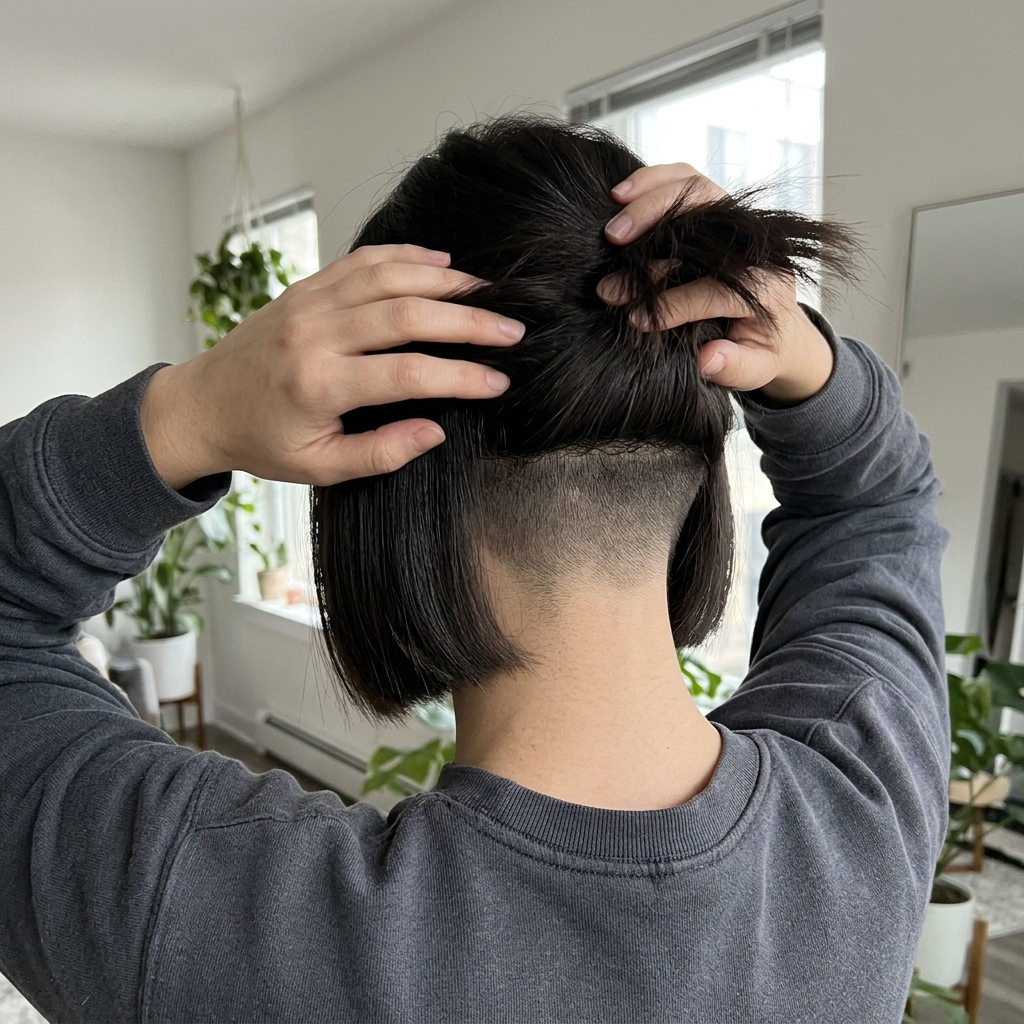
A section at the nape, or sometimes above one ear, is clipped short with clippers. The chin-length hair falls over it, so the undercut stays hidden until you lift or tuck your hair. Thick straight hair benefits most, because removing the underneath section reduces weight and drying time dramatically.
Wear it down for a classic bob, or tie it up to reveal the short nape. The clipped area needs a buzz every 3–4 weeks to stay crisp, so factor that into your schedule.
Best for: very thick, high-density straight hair
- Length: 8–10 inches (clipped nape under 1 inch)
- Maintenance: High
- Styling time: 10 min
- Trim every: 6–8 weeks (undercut every 3–4 weeks)
- Color touch-up: Not needed unless colored
19. Blunt Bob with Micro Bangs

Micro bangs are cut well above the eyebrows, typically halfway up the forehead. Paired with a blunt chin bob, they make a bold, graphic frame. Straight hair is the easiest texture to wear them with, since there’s no curl to shrink or spring up unexpectedly.
They highlight the eyes and brows, so they suit people who like attention on their features. Cowlicks at the front hairline can make micro bangs split, so check yours before committing. Fringe trims every 2–3 weeks keep them at the intended length.
Best for: fine to medium straight hair, oval or long face shapes
- Length: 8–10 inches
- Maintenance: High
- Styling time: 10 min
- Trim every: 6 weeks (bangs every 2–3 weeks)
- Color touch-up: Not needed unless colored
20. Copper Glossed Chin Bob

Rich copper color on a sleek chin bob is the boldest option on the list. Straight hair reflects light across the whole surface, so red tones look vivid and saturated. Light to medium natural bases lift to copper most easily. Dark brunette hair usually needs lightening first, which adds cost and processing.
Copper also fades faster than most shades. Plan for a gloss every 4–6 weeks, wash with cool water, and use a color-depositing conditioner weekly to keep the tone from going dull or brassy.
Best for: fine to medium straight hair, light to medium natural base
- Length: 8–10 inches
- Maintenance: High
- Styling time: 10 min
- Trim every: 6–8 weeks
- Color touch-up: Gloss every 4–6 weeks; full color 8–10 weeks
How Do I Choose the Right Chin-Length Haircut for Straight Hair?
Start with your density, then your face shape, then your routine. Fine hair looks fullest with blunt or micro-layered shapes. Thick hair needs weight removed through ghost layers, graduation, or an undercut. Next, match the angle and part to your face. Finally, choose a cut whose styling time and trim schedule match how much effort you’ll realistically put in.
Density first. Pinch your ponytail at the base. If it’s thinner than a quarter-inch across, treat your hair as fine. Fine hair should keep its weight at the ends. Hair that fills your hand needs bulk removed from the inside.
Face shape second. Round faces benefit from height and angles: a deep side part, an A-line, or asymmetry. Square faces soften with point-cut or razored ends instead of a hard blunt line at the jaw. Long faces gain balance from bangs and width at the sides.
Lifestyle third. If you won’t style daily, pick the classic blunt bob, Italian bob, or point-cut bob. Bangs, undercuts, and graduated shapes all need trims every 2–6 weeks.
Which Chin-Length Cuts Work Best for Fine vs. Thick Straight Hair?
Fine straight hair looks best in cuts that keep weight at the perimeter, like blunt bobs, micro-layered bobs, and A-lines. Thick straight hair looks best in cuts that remove weight internally, like ghost-layered bobs, graduated bobs, razor cuts, and undercuts. The difference comes down to strand count: fine hair has too little to spare, and thick hair has too much to sit flat.
With fine hair, heavy layering thins out the ends and exposes the scalp at the crown. Volume should come from root products and blow-drying, not from removing hair. Thick hair behaves the opposite way. Left one-length, it builds a triangular shape that widens below the ears. Removing bulk lets it sit closer to the head.
Straight hair with a slight bend, sometimes called Type 1C or loose 2A, is the exception. Blunt lines can look uneven on it as the bend pulls ends in different directions. Point-cut, razor-cut, and shag shapes work with that movement.
How Do I Care for a Chin-Length Cut at Home?
- Wash with a gentle shampoo every 2–3 days. Straight hair shows oil quickly because oil travels easily down a smooth strand. Use a dry shampoo at the roots between washes. Choose a color-safe shampoo if you have highlights or copper.
- Condition mid-lengths to ends only. Conditioner at the roots flattens straight hair, especially fine hair.
- Use a heat protectant every time. Short cuts show split ends sooner because the ends sit right at the jaw, where damage is visible.
- Dry the root direction first. Blow-dry roots against their natural fall for lift, then smooth the lengths.
- Finish the ends with the right tool. Use a round brush for an under-curve, a flat iron for a sharp line, or your fingers and texture spray for movement.
- Sleep on a silk or satin pillowcase. It reduces friction that causes bedhead kinks and frizz at the nape.
- Book trims before the shape collapses. Most chin-length cuts lose their line in 6–8 weeks.
Frequently Asked Questions
Are chin-length haircuts good for straight hair?
Yes, straight hair is one of the best textures for chin-length cuts because it shows clean lines and holds shape well. The catch is that it also shows mistakes, so precise cutting matters. Fine straight hair looks fullest in blunt shapes, and thick straight hair needs internal weight removal.
Will a chin-length bob make my face look rounder?
A bob that ends right at the widest part of your face can emphasize roundness. A-line angles, deep side parts, and asymmetrical lines create vertical movement that balances a round face. Adding root lift at the crown also lengthens the overall silhouette.
How often should I trim a chin-length bob?
Most chin-length bobs need a trim every 6–8 weeks to keep their shape. Graduated bobs and undercuts need trims every 3–6 weeks. Bangs typically need a fringe trim every 2–4 weeks depending on how short they’re cut.
What is the difference between a bob and a lob?
A bob ends between the earlobe and the jawline, often right at the chin. A lob, short for long bob, ends between the jaw and the collarbone. Lobs are usually easier to tie back, while bobs hold a sharper shape.
Can fine straight hair have layers at chin length?
Fine straight hair can have layers, but they should be minimal and placed only at the top, like micro layers. Heavy layering removes too much hair from the ends and can make the cut look thin. A mostly blunt perimeter keeps fine hair looking fuller.
Can I wear a chin-length bob up?
Most chin-length bobs can be pulled into a small low ponytail or a half-up style using a few bobby pins to catch shorter pieces. Cuts with an undercut or graduation are harder to tie back fully. Clips and headbands are the easiest way to wear the length off the face.
How long does it take to style a chin-length bob?
Most chin-length bobs take 5–15 minutes to style. Air-dry-friendly cuts like the point-cut or Italian bob are on the fast end, while glass-hair finishes and flipped styles take closer to 20 minutes. Thick hair adds drying time unless it has internal layers.
Find Your Chin Length Cut
If you want the easiest daily routine, start with the classic blunt bob or the Italian bob. If your straight hair is thick and puffs out, go for ghost layers or a hidden undercut. If your fine hair falls flat, try micro layers with a strong baseline. For something bolder, micro bangs, asymmetry, or copper color all make a statement in one appointment.
The best chin-length haircuts for straight hair work with your density instead of against it. Save your favorites to a Pinterest board so you can show the exact shape at your next appointment. Then explore more short-hair guides from Hairstyle Inspirations to plan your next look.