
40 Flattering Chin Length Haircuts for Fine Hair (2027 Trends)

Fine hair tends to go limp exactly where you want it fullest: at the ends. Past your shoulders, the bottom few inches can turn see-through. Too short, and you may feel exposed. Chin length haircuts for fine hair sit in the middle. Taking off the weight at the jaw lets fine strands hold their shape, so the perimeter looks thicker and styling takes minutes instead of a long round-brush session.
What matters is the right line, the right layer placement, and the right finish for your texture. Below, Hairstyle Inspirations walks through 20 chin-length cuts, from glassy blunt bobs to tapered coily shapes. Each one comes with honest notes on upkeep, styling time, and who it flatters most.
Quick Overview: Key Points
- Best for very fine, straight hair: a one-length blunt bob. A single solid line makes the ends look densest.
- Best for fine strands with thick density: a graduated bob or one with internal layers. Both remove bulk without thinning the edge.
- Lowest maintenance: the soft tousled bob or a curly bob cut dry. Both grow out without an awkward shelf.
- Best for curls and coils: shapes cut dry, curl by curl, so the final length lands at the chin after shrinkage.
- Trim frequency: every 6–8 weeks for blunt lines, and every 8–10 weeks for layered, wavy, and curly cuts.
- Color touch-ups: a gloss every 6–8 weeks, and lived-in highlights every 3–4 months.
What Is a Chin Length Haircut for Fine Hair?
A chin-length haircut for fine hair is a cut whose longest pieces land between the jawline and about an inch below the chin. It is shaped to make thin strands look fuller. Most versions rely on a strong perimeter and minimal or hidden layering. Volume is placed at the crown without removing weight from the ends.
“Fine” describes the width of each individual strand, not how much hair you have. That is called density. You can have fine strands and low density, which means truly thin hair, or fine strands and high density, which means lots of soft, slippery hair. That distinction changes which cut works.
A chin-length cut is different from a lob, which falls to the collarbone, and from a short bob, which sits at or above the earlobe. It is long enough to tuck and style but short enough to keep fine ends from looking wispy. Heavy thinning shears and aggressive razor work usually backfire on fine hair because they remove the density you’re trying to show off.
20 Chin Length Haircuts for Fine Hair
1. Soft Tousled Chin Bob with Invisible Layers

This bob looks like it air-dried well. It has a slightly bent shape, ends that flick in different directions, and no visible steps. Your stylist cuts short “invisible” layers into the underneath sections, so the hair lifts more at the root while the outer perimeter stays full.
On fine straight or slightly wavy hair, you get movement without the wispy ends that heavy face layers can create. To style it, rough-dry with a lightweight volumizing mousse at the roots. Then twist two or three random sections around a flat iron for a lived-in bend that lasts into day two.
Best for: Fine straight to wavy hair, low to medium density
- Length: 7–9 inches
- Maintenance: Low
- Styling time: 10 min
- Trim every: 8–10 weeks
- Color touch-up: 3–4 months (if highlighted)
2. Rounded “Italian” Bob with Bouncy Ends

The Italian bob is rounder and fuller than a crisp blunt cut, with ends that curve softly toward the jaw. On fine hair, that volume comes from styling rather than cut-in bulk. A round brush blowout works, or three large Velcro rollers set at the crown while you do your makeup.
Medium brown and deep brunette shades show off the glossy curve, because dark hair reflects light along every bend. The width at cheekbone level flatters oval, heart-shaped, and longer faces. Plan on real time with a blow-dryer, because this cut only looks right when it is styled.
Best for: Fine straight hair, medium density, brunette shades
- Length: 8–10 inches
- Maintenance: Medium
- Styling time: 20 min
- Trim every: 6–8 weeks
- Color touch-up: Gloss every 6–8 weeks
3. One Length Blunt Bob at the Chin

The simplest cut is often the most effective one for very fine, straight hair. Every strand is cut to a single line at the chin, usually on dry or blown-smooth hair so the edge is precise. That hard perimeter puts all your hair’s weight in one place, so the ends look solid instead of transparent.
It works on sleek blondes, deep espresso, and every shade in between. A clean line does show frizz, so keep a smoothing cream nearby. To style it, blow-dry downward with a paddle brush, then press the ends lightly with a flat iron so they meet the jaw evenly.
Best for: Very fine straight hair, low density
- Length: 7–9 inches
- Maintenance: Medium
- Styling time: 10 min
- Trim every: 6–8 weeks
- Color touch-up: 6–8 weeks (single-process)
4. Center Part Glass Bob

The glass bob is a high-shine version of the blunt bob. It has a razor-straight center part, a flat, mirror-like finish, and ends that hang at the jaw like a curtain. The “glass” look comes from smoothing every cuticle, which gives fine hair an advantage: it straightens quickly and reflects light evenly.
Cool blondes, inky black, and glossy auburn all photograph well this way. A center part can flatten fine roots, so mist a root-lifting spray at the crown before drying. Finish with one drop of lightweight shine serum on the ends only.
Best for: Fine straight or lightly wavy hair, any density
- Length: 7–8 inches
- Maintenance: Medium
- Styling time: 20 min
- Trim every: 6–8 weeks
- Color touch-up: Clear gloss every 6–8 weeks
5. Deep Side Part Bob with a Soft Swoop

Moving your part two inches to one side instantly stacks more hair on top. That makes a deep side part one of the easiest volume tricks for fine strands. The cut itself is a classic chin bob, left slightly longer on the heavy side. That way the swoop falls across the brow and tucks softly at the cheek.
It softens a square jaw and helps tame a cowlick at the front hairline. To style it, blow-dry the front section in the opposite direction of your part. Then flip it back over for lift that holds all day.
Best for: Fine straight to wavy hair, low density, front cowlicks
- Length: 7–10 inches
- Maintenance: Low
- Styling time: 10 min
- Trim every: 8 weeks
- Color touch-up: 3–4 months
6. Ear Tuck Bob

This bob is cut a little longer than the chin at the front and slightly shorter behind the ears, so it is meant to be tucked on one or both sides. Tucking shows off the jawline and earlobe, which makes it a good backdrop for statement earrings. The untucked length keeps fine hair looking full around the face.
It’s a practical choice if you’re growing out bangs or tend to push your hair back all day. On straight fine hair, a light texture spray keeps the tucked section from slipping out. Pale ash blonde and soft caramel make the angle of the tuck easy to see.
Best for: Fine straight hair, low to medium density
- Length: 7–9 inches
- Maintenance: Low
- Styling time: 5 min
- Trim every: 8–10 weeks
- Color touch-up: 3–4 months
7. Curtain Bang Chin Bob

Curtain bangs part at the center and sweep outward toward the cheekbones, blending into the rest of the bob. On fine hair they do two jobs. They pull hair forward from the top of the head to create the look of more density, and they disguise a high or sparse hairline.
Keep them long, from cheekbone to lip length, so they don’t need a daily fight. While the hair is still damp, round-brush the bangs back and away from your face. Let the rest of the bob dry naturally, so the polished fringe contrasts with softer lengths.
Best for: Fine straight or wavy hair, thin front hairline
- Length: 7–9 inches (bangs 4–6 inches)
- Maintenance: Medium
- Styling time: 10 min
- Trim every: 8 weeks (bangs every 3–4 weeks)
- Color touch-up: 3–4 months
8. Subtle A Line Chin Bob

An A-line bob is shorter in the back than in the front, which creates a gentle forward angle. A subtle version has about an inch of difference. The front pieces stay at the chin while the back lifts away from the neck, giving fine hair more shape at the crown without visible stacking.
The longer front lines lengthen the jaw, which flatters round faces. The angle also hides small unevenness, so this cut holds up to a quick rough-dry better than a strict blunt bob. Rich chestnut and mushroom brown add depth to the slope.
Best for: Fine straight hair, medium density, round faces
- Length: 6–9 inches (back to front)
- Maintenance: Medium
- Styling time: 10 min
- Trim every: 6–8 weeks
- Color touch-up: 3–4 months
9. Graduated Bob with a Stacked Nape

Graduation means short, overlapping layers at the nape that build into a curved, fuller shape at the back of the head. For fine strands with high density, this removes heavy weight underneath and adds lift at the occipital bone, the rounded spot at the back of your skull.
The front stays at chin length, so from the side the shape looks sculpted, a bit like a soft wedge. The curve depends on precise cutting and frequent trims, so this cut suits someone who books salon visits regularly. Blow-dry the back with a small round brush for the most lift.
Best for: Fine strands with thick density, straight hair
- Length: 4–8 inches (nape to front)
- Maintenance: Medium
- Styling time: 15 min
- Trim every: 5–6 weeks
- Color touch-up: 3–4 months
10. Bent Wave Chin Bob

Waves make fine hair look thicker because each bend creates space between strands. This bob is cut with slightly softened ends. To style it, clamp a section in a flat iron, rotate a half turn, and glide down. Leave the last half inch straight for a modern finish.
Dirty blonde and honey-highlighted hair show the dimension in every bend. Heavy sea-salt sprays can leave fine hair crunchy. A weightless texturizing spray or a dry shampoo gives grip without stiffness. Apply heat protectant before every pass.
Best for: Fine straight to wavy hair, low to medium density
- Length: 7–9 inches
- Maintenance: Medium
- Styling time: 15 min
- Trim every: 8 weeks
- Color touch-up: 3–4 months
11. Chin Length Shag with Feathered Ends

A chin-length shag works on fine hair when the layers stay light and sit around the face and crown, leaving the perimeter mostly intact. You get piecey, feathered ends, some lift on top, and a slightly ’70s attitude. Natural 2A–2C waves give it the most movement.
Straight hair needs a texture spray to keep the pieces separated. It’s a good option if you want personality without committing to bangs, though a wispy fringe can be added later. To style it, scrunch a lightweight foam into damp hair and diffuse on low heat.
Best for: Fine wavy hair, medium to thick density
- Length: 6–9 inches
- Maintenance: Medium
- Styling time: 10–15 min
- Trim every: 8–10 weeks
- Color touch-up: 3–4 months
12. Curly Chin Bob Cut Dry

Type 3 curls shrink, sometimes by several inches, so a wet-cut bob can spring up far shorter than planned. This bob is cut dry, curl by curl. Your stylist can see exactly where each spiral lands, so the final shape sits at the chin instead of near the ear.
On fine curls, a rounded perimeter with no heavy thinning keeps definition intact. Rich creams and butters weigh fine curls down, so use lighter products. Apply a lightweight curl cream or gel to soaking-wet hair, scrunch, then diffuse or air-dry. Once the hair is completely dry, scrunch out the gel’s stiff cast.
Best for: Type 3A–3C curls, fine strands, any density
- Length: 8–12 inches stretched
- Maintenance: Low
- Styling time: 15 min (wash days)
- Trim every: 10–12 weeks
- Color touch-up: 4–6 months
13. Tapered Coily Chin Length Shape

A tapered shape is shorter at the nape and sides and longer at the crown and front, where it reaches about chin length when the coils are stretched. The result is a rounded, sculpted silhouette for Type 4 hair. Fine coils can be fragile and prone to breakage.
This shape keeps length where it shows most and reduces tangling at the nape. Twist-outs, finger coils, and wash-and-gos with a defining gel all hold well in it. Espresso, deep burgundy, and honey-brown rinses add dimension without heavy lightening. Protect your ends at night with a satin bonnet or pillowcase.
Best for: Type 4A–4C coils, fine strands, medium to high density
- Length: 6–10 inches stretched
- Maintenance: Medium
- Styling time: 20–30 min (wash days)
- Trim every: 8–12 weeks
- Color touch-up: 3–4 months
14. Silk Press Chin Bob

A silk press straightens naturally curly or coily hair with a blow-dryer and flat iron, with no chemical relaxer. It produces a swingy, light-reflecting bob that returns to its natural texture when washed. At chin length there’s less hair to press, so fewer passes of the iron are needed.
That matters for fine strands, which are more easily heat damaged. Book a stylist experienced with textured hair who uses heat protectant and moderate temperatures. Wrap your hair in a silk scarf at night. The press lasts until your next wash or until humidity wins.
Best for: Type 3–4 curls and coils, fine strands
- Length: 8–10 inches pressed
- Maintenance: High
- Styling time: 60–90 min (salon)
- Trim every: 8–10 weeks
- Color touch-up: 3–4 months
15. Lived In Bronde Bob with Babylights

Babylights are ultra-fine highlights woven close to the root, imitating the way a child’s hair lightens in the sun. On a chin bob, they scatter tiny ribbons of brightness through the hair. That adds visual texture and makes the scalp less noticeable through fine strands.
Pair them with a soft root smudge, a toner blended at the base, so the color grows out gently and you can space out appointments. Bronde mixes golden blonde with light brown and flatters neutral and warm undertones. It looks good both sleek and softly bent.
Best for: Fine straight to wavy hair, light brown to dark blonde base
- Length: 7–9 inches
- Maintenance: Medium
- Styling time: 10 min
- Trim every: 8 weeks
- Color touch-up: 3–4 months (gloss every 6–8 weeks)
16. Chin Bob with a Money Piece

A money piece is a bright, face-framing streak placed on the front sections on either side of your part. On a chin bob, those two panels catch light right around your face. They draw attention to your eyes and cheekbones and add dimension to fine hair without lightening your whole head.
It works on brunette, red, and blonde bases. On dark hair, a caramel or golden money piece looks softer than icy platinum. Only the front gets lightened, so it’s a low-commitment way to try brighter color. If brassiness creeps in, use a purple or blue shampoo once a week.
Best for: Fine straight or wavy hair, medium to dark base
- Length: 7–9 inches
- Maintenance: Medium
- Styling time: 10 min
- Trim every: 8 weeks
- Color touch-up: 6–10 weeks (front sections only)
17. Copper Gloss Bob
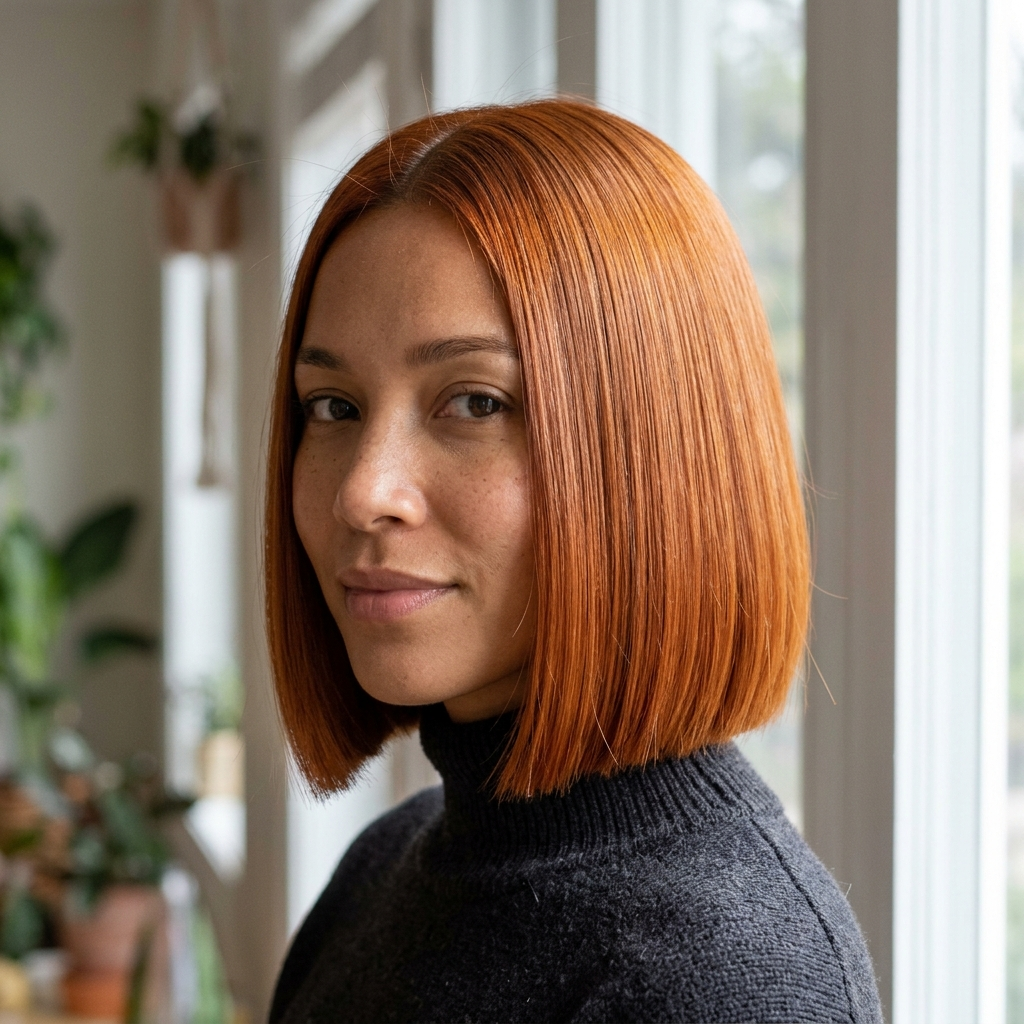
A saturated copper on a sleek chin bob creates a solid block of color, which makes fine hair look denser than it is. A high shine gloss over the top deepens the effect. Copper tends to flatter warm and neutral undertones. If your undertone is cool, a cinnamon-auburn with more red than orange is usually more forgiving.
Red tones fade faster than most shade families, so this is a higher upkeep choice. To slow fading, wash in cool water, use a color safe sulfate free shampoo, and add a copper color depositing conditioner between appointments.
Best for: Fine straight hair, light to medium natural base
- Length: 7–9 inches
- Maintenance: High
- Styling time: 10 min
- Trim every: 6–8 weeks
- Color touch-up: Gloss every 4–6 weeks
18. French Bob with Baby Bangs

The French bob sits slightly above the chin, between the lip and the jaw, and is paired with a short fringe that skims the eyebrows. Its appeal is a slightly undone finish, with no flat-ironing to perfection. On fine hair, the bangs pull density forward to the face, and the shorter length keeps the ends looking thick.
It suits oval and heart-shaped faces and anyone with strong brows to frame. A stubborn cowlick at the hairline can make baby bangs tricky. Let the hair air-dry with a pea-sized amount of texture cream for a relaxed look.
Best for: Fine straight or slightly wavy hair, low density
- Length: 6–8 inches (bangs 2–3 inches)
- Maintenance: Medium
- Styling time: 10 min
- Trim every: 6–8 weeks (bangs every 2–3 weeks)
- Color touch-up: 3–4 months
19. Asymmetrical Chin Bob

One side falls at the chin and the other is cut an inch or two shorter, angled toward the jaw. The result is a graphic, editorial outline that stands out instantly. Straight fine hair shows the angle best, especially with a smooth, glossy finish and a deep part on the longer side.
Jet black and platinum maximize the contrast of the line. The asymmetry only reads as intentional when it’s crisp, so expect trims every five to six weeks. Blow-dry the longer side forward with a paddle brush to sharpen the slope.
Best for: Fine straight hair, low to medium density
- Length: 5–9 inches (short to long side)
- Maintenance: High
- Styling time: 15 min
- Trim every: 5–6 weeks
- Color touch-up: 6–8 weeks
20. Chin Bob with a Hidden Undercut
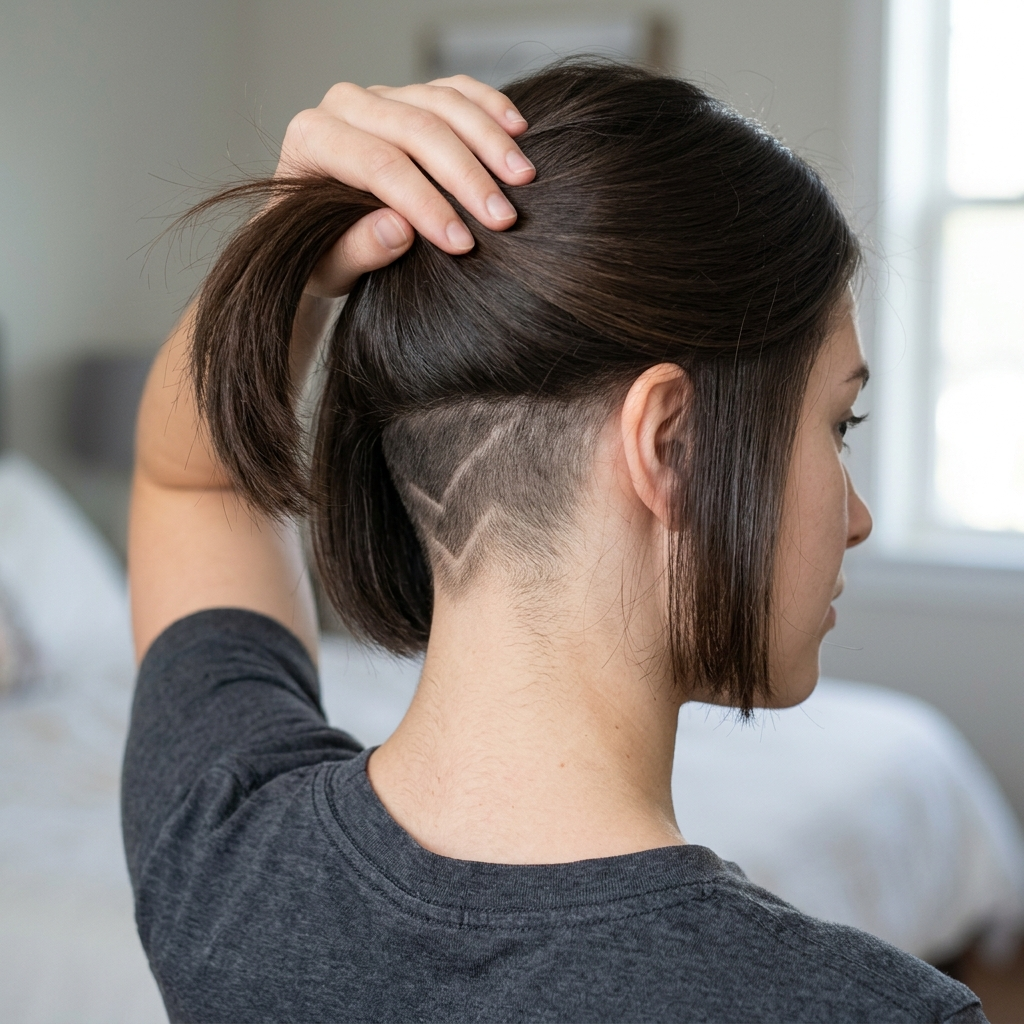
For fine strands with very high density, a nape or side undercut removes bulk that otherwise makes a bob puff out at the bottom. In an undercut, a section underneath is clipped close to the scalp. The top layer covers it, so you see a sleek chin bob until you pull your hair up and reveal the short section.
Some people add a shaved design for fun. Your hair dries faster and sits flatter at the nape. It’s the boldest commitment here, because growing out an undercut takes several months of in-between styling.
Best for: Fine strands with thick density, straight to wavy hair
- Length: 7–9 inches (undercut ¼–½ inch)
- Maintenance: Medium
- Styling time: 10 min
- Trim every: 6–8 weeks (undercut every 3–4 weeks)
- Color touch-up: 3–4 months
How Do I Choose the Right Chin Length Cut for Fine Hair?
Start with your texture and the time you’ll actually spend styling. Very fine, straight hair looks fullest in a blunt or glass bob. Waves suit soft, lightly layered shapes, and curls and coils suit cuts done dry. Then factor in your face shape, your natural part, and whether you can commit to trims every six to eight weeks.
- Face shape: Round faces benefit from length just below the chin or a subtle A-line. Square jaws soften with side parts and bent waves. Oval and heart shapes carry rounded Italian and French bobs easily.
- Skin undertone: Warm undertones glow with copper, golden bronde, and caramel. Cool undertones suit ash blonde, espresso, and blue-black. Neutral undertones can move between the two.
- Lifestyle: If you air-dry and go, choose the tousled bob, the curly dry cut, or the ear-tuck bob. If you enjoy a daily blowout, the Italian and glass bobs reward that effort.
- Budget: Graduated, asymmetrical, and undercut shapes need the most frequent salon visits. Soft, layered, and curly cuts stretch the longest between appointments.
Which Chin Length Cuts Work Best for Fine, Thick, Wavy, Curly, or Coily Hair?
The best cut depends on how your hair holds shape. Fine, low-density hair needs a solid perimeter. Fine strands with high density need weight removed from the inside. Wavy hair needs light layers to bring out movement. Curls and coils need dry cutting, so length is measured after shrinkage rather than guessed while wet.
- Fine, low density: Blunt lines matter most here. Every layer removes hair from the ends, which is where thinness shows first.
- Fine strands, high density: Hair can look bulky at the bottom, so graduation, internal layers, or a hidden undercut keep the shape sleek.
- Wavy (2A–2C): A few strategic layers let each wave sit in its own space. Without them, waves can clump into a triangle shape.
- Curly (3A–3C): Spirals stack on each other, so a rounded, dry-cut perimeter keeps curls balanced instead of flat on top and wide at the bottom.
- Coily (4A–4C): Tapering and stretched-length measurements protect fragile ends and make styling from twist-outs to silk presses easier.
How Do I Care for a Chin Length Cut at Home?
To care for chin-length fine hair, wash it with a lightweight volumizing or color-safe shampoo. Condition only the mid-lengths and ends, use heat protectant before every hot tool, and keep up regular trims. Short cuts show damage quickly, because split ends at the chin are right in your line of sight.
- Shampoo for your scalp. Most fine hair gets oily faster, so washing every one to two days is common. Curls and coils often do better with one or two wash days a week.
- Condition from the ears down. Conditioner at the roots flattens fine hair. Choose lightweight formulas labeled for volume or fine hair.
- Protect before heat. Use a heat protectant spray on damp hair, and keep flat irons on moderate settings.
- Use root lift, not weight. Mousse, root spray, and dry shampoo add grip. Heavy oils and butters drag fine hair down.
- Gloss between color appointments. An at-home or salon gloss restores shine and tone to faded color.
- Sleep on satin or silk. Less friction means less frizz and breakage, especially for curls, coils, and pressed hair.
How Do I Grow Out a Chin Length Haircut?
To grow out a chin bob, take micro-trims of about a quarter inch every 8–10 weeks to keep the perimeter even. Let the back catch up to the front, and use a gloss to refresh faded color. The awkward phase usually comes at the shoulders, when ends start flipping outward.
Graduated, asymmetrical, and undercut shapes take the longest to grow out because the shortest sections have to reach the longest ones. Ask for trims that only reshape the back and leave the front alone. Bobby pins, low knots, and tucking your hair behind your ears help you through the in-between months. If your color fades unevenly during the grow-out, a root smudge or demi-permanent gloss blends the line between new growth and older color without a full appointment.
Frequently Asked Questions
Is chin length hair good for fine hair?
Yes, chin length is one of the most flattering lengths for fine hair because it removes the weight that pulls strands flat and keeps the ends dense. Shorter hair also dries faster and tends to hold volume longer between washes.
Should fine hair have layers in a bob?
Fine hair can have layers in a bob, but they should be minimal, soft, or internal. Heavy, choppy layers remove too much hair from the ends and can make a bob look thinner. Long face-framing pieces or invisible layers add movement without that thinning effect.
Will a chin length bob make my face look rounder?
A chin bob can widen a round face if it ends at the widest point of the face with a blunt, rounded shape. A subtle A-line, a deep side part, or length that lands just below the chin creates longer lines that balance roundness.
How often should I trim a chin length cut for fine hair?
Most chin-length cuts on fine hair need a trim every 6–8 weeks to keep the ends dense and the line crisp. Layered, wavy, and curly cuts can usually stretch to 8–10 weeks, while asymmetrical and graduated shapes need trims closer to every 5–6 weeks.
What is the best chin length haircut for fine, thin hair?
A one-length blunt bob is usually the best chin-length haircut for fine, thin hair because a single solid perimeter makes the ends look thickest. Adding a deep side part or curtain bangs increases the look of fullness.
Can you get a chin length bob with fine curly hair?
Yes, fine curly hair works well at chin length when the cut is done dry, curl by curl, so shrinkage is accounted for. Lightweight curl creams and gels keep fine curls defined without weighing them down.
Find Your Chin Length Cut
If you want the fullest-looking ends with the least effort, start with a one length blunt bob. For movement without thinning the edges, the soft tousled bob or the bent-wave bob adds texture. Curly and coily hair looks best in rounded shapes cut dry.
If you’re ready for something bolder, try copper, an asymmetrical line, or a hidden undercut. The right chin-length cut for fine hair matches your texture and the time you actually spend styling. Save your favorites to Pinterest so you have photos ready for your next appointment, and explore more fine-hair and bob guides on Hairstyle Inspirations.


